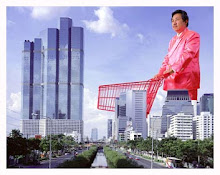
"Notes Towards an Understanding of Thai liberalism"
Michael K. Connors
forthcoming in Bangkok, May 2010: Perspectives on a Divided Thailand. Singapore: Institute of Southeast Asian Studies (ISEAS) edited by Mike Montesano, Pavin Chachavalpongpun and Aekapol Chongvilaivan.
(parts of this piece have previously appeared in The Age and this blog)
It is easy to understand the plausibility of the case that the principal struggle unfolding in Thailand today pits democracy against authoritarianism. The events of the past four years seem to speak for themselves: the 2006 coup against the ‘pro-poor’ Thaksin government, the manipulated pro-military constitutional referendum of 2007, the judicial dissolution of the Thai Rak Thai (2007) and its successor People’s Power (2008) parties, and the subsequent military-supported installation of a Democrat-led coalition government in late 2008. Then of course comes the spilling of blood that feeds the democracy-authoritarianism narrative: the bloody crackdown in April – May 2010 against Red Shirt protestors and the imposition of a draconian state of emergency, human rights violations, and the suspension of due process for hundreds of political detainees.
The "democratic versus authoritarian” narrative, connected to the idea of a popular struggle against a rich establishment, has captured international attention. It is also at the heart of the self-presentation of the United Front for Democracy Against Dictatorship (UDD), so brilliantly exemplified by the etching of the world phrai (commoner) onto red tee-shirts. There are elements of truth in this formulation. But the same general tension – democracy versus authoritarianism – could just as easily substitute for a short history of human society, with one problem: it explains everything generally, but nothing particularly. In recent times the formulation has led to skewed analysis of Thailand’s crisis, and to a cheer-squad mentality that fails to capture intra-class/state conflict and inter-class/state agency cooperation. It obscures the nature of Thailand’s recent past and its likely trajectory. Moving beyond such a simplistic analysis makes possible a more serious probing of the specific nature of the conflict and of the possibilities for its resolution. Early-twentieth-century Marxist Antonio Gramsci offers the best argument against simplistic representation: "A given socio-historical moment is never homogeneous; on the contrary, it is rich in contradictions." To understand Thailand’s rich contradictions, it is better to drop the catch-all explanation and to come to grips with the specificity of the crisis at hand.
These notes toward an understanding of Thai liberalism are, I suppose, an uncomfortable call for observers to stand at some intellectual distance from the daily malaise of democracy in Thailand and to seek more sensitive lenses through which to examine both the interests and ideologies behind the competing claims of now fundamentally antagonistic elites, and the popular bases with which these interests and ideologies are articulated.
While rich in contradiction, the Thai context nevertheless has a dominant dynamic. That dynamic includes the largely unexplained pacting during 2005 and 2006 of statist conservatives and elite liberals against the emergent and competitive authoritarianism represented by Thaksin Shinawatra. It also includes the re-pacting of those same elements upon the emergence of the Red Shirt movement (itself composed of some liberal elements).
I say “unexplained” because, for the most part, political liberalism in Thailand is not taken seriously by analysts. It is seen as rhetorical and mealy-mouthed. When it is recognised, it is viewed as having been eclipsed by the instrumental politics of competing networks. There is thus nothing to explain. Scratch a political liberal in Thailand, and underneath is a snivelling courtier ready to serve monarchy, military and bureaucracy, or any paymaster – or so it is claimed. This view of Thai elites holds that ideas and social projects do not matter; only venal interest are deemed relevant. The view also broadly endorses a conspiratorial understanding of politics. This understanding has it that a monolithic elite self-consciously acts as the puppet master in all matters. This view does not recognize the fragmented and hostile relations between liberals and conservatives, because it takes Thai liberals and conservatives to be, fundamentally, one and the same.
At another level, a number of non-governmental organizations, activists and public intellectuals have taken a non-antagonistic, if not sympathetic, position to the anti-Thaksin side. Arguably, this position makes these groups and individuals distantly complicit in the authoritarian resolution to the crisis. But, just as differences between liberals and statists are elided in the conventional narrative, so too are those between elite liberalism and the social liberalism espoused by Thailand’s NGOs. NGOs’ failure to rally to the Red Shirts leads critics to bundle them together as part of the amaat (the bureaucratic-aristocratic establishment), as if those who have struggled for social justice over the last generation have suddenly become concerned only with their own interests and those of Thai elites. By the force of this logic, those who do not side with the Red Shirts are merely morally defective and opportunistic.
A morally charged critique based on the alleged defective character of those with whom one disagrees does not advance understanding of different strategic positions. Rather, it leaves one in the realm of puppet play, of good and evil, and of caricature. It results in accounts lacking in explanatory power, their rhetorical force notwithstanding.
Illumination of the contradiction of Thai liberalism’s pact with statist conservatism, only one of many pacts now in operation, requires an answer to one crucial question: why was Thaksin deposed? The answer is clear: Thaksin threatened a tentative liberal-conservative pact, one that emerged in the 1990s, on sharing power. The pact put Thailand on a trajectory toward a more liberal democratic polity. A variety of social forces, their interests differentially entangled in that project, mobilised against Thaksin. This mobilisation culminated in the September 2006 coup d’état. Subsequent developments have certainly transformed the nature of the struggle from an intra-elite contest to a broader societal conflict.
Confronting the transformation of the pro-Thaksin side into a messily conjoined quasi-popular/counter-elite movement advancing egalitarian positions, the liberal-conservative pact has hardened. The “soft coup” of 2006 has become a distant memory.
In this moment of profound structural crisis, Prime Minister Abhisit Vejjajiva symbolises the liberal pact with statist conservatives. His government’s maintenance throughout 2010 of the Emergency Decree invoked in April 2010 subsequent to the crushing of the Red Shirt rebellion reveals the foundations of sovereign power in force. But this is not naked power, even if it is abusive. Its purported aim is to prepare the ground for the realization of liberalism’s preferred state form in the post-crisis period. Such is Thai liberalism’s current internal logic and public message: judge us not by situational logic and actions, but by our long-term project, to which we now turn.
After the February 1991 coup – an attempt by statists and conservatives to roll back the emergence of a more open and democratic society - a politically liberal reform movement emerged in Thailand. Elites recognised that the semi-democracy of the 1980s was the creature of an age gone by. This movement resulted in the celebrated 1997 ''People's Constitution'', which formally enshrined liberal doctrine at the heart of the Thai state. Henceforth, executive power (rooted in a democratic mandate) would be subject to a variety of liberal checks and balances. An electoral commission and constitutional and administrative courts would scrutinise the exercise of that power. No one expected a smooth path to liberal democracy in Thailand. The military's corporate interests remained. Networks around the monarchy continued to wield power. Corruption was pervasive. The liberal project was understood to be gradual and generational.
Then the project came unstuck. While in government during the Asian economic crisis of 1997-2000, the liberally oriented Democrat Party failed to offer anything except implementation of an International Monetary Fund austerity program and the creation of a social-welfare safety valve in the form of the Social Investment Fund. Such liberal feebleness paved the way for Thaksin and his brand of authoritarian populism and ‘pro-poor’ policies.
During his term as prime minister (2001-06), Thaksin tore up the aspirational liberal settlement. His disregard for human rights and the institutions intended to subject executive power to checks and balances is well documented. So too is the level of electoral support that he enjoyed, which won him power in 2001 and 2005. His project was a modernized and globalized Thai capitalism whose midwife would be elected authoritarianism. Liberalism, such as it was, and democracy, such as it could be, parted ways.
The Yellow Shirt movement against Thaksin that arose in 2005-06 brought together liberal middle-class elements, members of the rural poor and unionists opposed to privatisation programs. It also included elite conservative elements fearful that Thaksin was pushing them out of their traditional roles as powerbrokers. These elements viewed Thaksin as a threat to the social order and, importantly, to the monarchy.
Since 2006, Thai liberals have joined with conservative elements in the state, and with the Yellow Shirts, to defeat Thaksin and his supporters. Together, they played a role in bringing down the elected pro-Thaksin governments in late 2008. They were and are driven by a flawed logic of gradually returning Thailand to something like the liberal-conservative settlement of 1997, with all of its compromises and more besides. Liberalism’s dependence on its erstwhile statist competitors in the military and bureaucracy make those additional compromises necessary.
From liberal-conservative pact to liberal authoritarianism
Two compelling fears drive Thailand’s now transformed liberal authoritarianism, by which I mean the use of authoritarian means to return Thailand to its elitist liberal trajectory.
The first is fear that an alternative modernizing network of politicians, statists, and business, under the leadership of Thaksin, and possibly with support of a new monarch, will block a return to the circumscribed but pluralistic competition for power that characterized the emergent liberal-conservative period of the 1990s to early 2000s. ). Corporate interest also drives those who would stand to lose from the end of that regime of circumscribed competition. And when self-interest finds justification in pious commitment to a visibly threatened social order – brutal action unremarkably follows. Thaksin’s modernizing authoritarianism was antagonistic to an established historical bloc whose members believed that, all things being equal, it was edging Thailand in the right direction. That bloc is not intent on establishing a Burmese-style junta, or on returning to policies of benign neglect of the poor. Should it succeed in its goals, the most likely outcome will be a partially reformed (for survival requires some degree of reform) but nevertheless elite-controlled order. Evidence for these likely goals is to be found in the way in which the Abhisit government is accelerating land reform and addressing other socio-economic grievances whilst simultaneously trying to bring political contestation under control.
A new logic is now also present, one that transcends earlier fears of populism. The roots of this second fear lie in apprehensiveness over the unleashed expectations of Thailand’s less powerful classes coupled with a relentless organizational drive to return to power by Thaksin. It is also rooted in concern over those classes’ new-found fury at the bare-faced authoritarian posture of the Abhisit government and its hardline backers in the Thai military. The very existence of armed elements in the Red Shirt camp (incredulously denied by Red Shirt sympathisers or explained away as a desperate strategy) fuels this contingent authoritarianism, and forces it to reveal itself.
In this post-coup phase, in which might is doubly right, situational logics and political choices have brought into being a reactionary societal current that gives partisan legitimacy to the government. Relief that the Red Shirts have been “dealt with” gives rise to exaltation of the “handlers.” Take as one example the adulation of Centre for Resolution of Emergency Situation spokesperson Colonel Sansern Kaewkamnerd, as in The Nation’s 30 May 2010 article “Saluting the kingdom's coolest colonel.” It is a legitimacy that rests on portraying the Red threat as criminal and terroristic, and therefore not worthy of political engagement.
The threat of social upheaval, of a world turned upside down, has brought all sorts of pathologies to the surface: witch-hunts, educational ostracism, dehumanising portrayals of those who disagree, bloodcurdling snobbery and a recapturing of the city of angels by sovereign consumers speedily spending the country out of crisis. Unsettled by the emergence of a rival state in the heartland of Bangkok during April and May of 2010, as exemplified by the imposition of Red Shirt authority on street corners and influence on sections of the state’s police and armed forces, people began to howl in mid-2010 for a political cleansing as malignantly intended as it would be destructive. Liberalism looks at itself in the mirror and wonders how it got to this state.
Thinking about liberalism as a problematic, not as a doctrine
The question arises, does what we are discussing have anything to do with liberalism? In reply, I would note that it is best to think of liberalism in general and in the Thai case in particular not simply as a philosophy of the conditions for individual autonomy, but as a response to the problems of governance in complex societies in which modern state structures emerge, power centres are plural, and conflict and public interest require regulation and adjudication to preserve defined liberties. At a minimum, liberal aspiration accords with the division and accountability of power. I am speaking more of a political than individually-centred philosophical liberalism. Liberalism, in its own way, asks, What is to be done?
What is to be done with an electorate – judged in part to be dependent and lacking in capacity because of information flows - that keeps returning to office (in 2005 and 2008) a political class that will move Thailand away from the liberal-conservative settlement of 1997? Thai liberalism is no different from historic forms of liberalism that feared the “tyranny of the majority” and the egalitarian impulse of democracy. Many liberals are disposed to support or at least condone aristocratic tutelage over citizens who need to be “developed” before they can be sovereign. It took several generations in many countries for liberalism to settle into democratic realities. It still does not quite fit, and liberals the world over must constantly deal with the populist underside of democracy and the illiberal nature of big business and the security state.
What is to be done with a political class that is highly corrupt and money-driven? Classic liberal themes of public interest, of conflict of interest, and of virtue come into play. Everywhere, liberals rally against the decline of virtue. But in its present moment, elite liberalism makes compromises and is articulated with corrupt or conservative elements “on the right side.” Its pragmatic side is a reflection of politics as the art of the possible. Think of the pragmatic alliance between the Democrat Party and its coalition partners. Presumably, virtue’s day will come.
What is to be done with the statist and conservative institutions of monarchy, military and bureaucracy, and with the networks that permeate them? Precisely because this problem deemed less serious than the Thaksinite threat, it is momentarily put aside. Should the Thaksinite and populist threat be neutralized, one may expect a return of the ongoing contest between liberal and statist conservative elements. That the peak statist element of “the network monarchy” is a gerontocracy gives the advantage to the elite liberal network.
One particular way in which liberals have sought to engage and gradually transform the monarchy is by embedding what I have called “royal liberalism”. In doing so they are re- enacting liberalism’s historical flirtation (in France and England) with monarchy as a guardian centre above “politics”, what leading Thai legal scholar Bowonsak Uwanno describes as the “the supreme ombudsman”. In that role, the crown supposedly acts as the liberal regulator, ensuring the division of power and protecting the public interest. Aside from its legitimating function, the idea of “royal liberalism” is a reforming, indeed disciplining discourse directed at the Thai monarchy and at those who mobilize the institution for illiberal purposes. It is a claim on the monarchy as a public institution. The aspiration for liberal monarchy is challenged by the reputed relationship between Thaksin and the Crown Prince. That relationship would raise the spectre of a weakened “ombudsman”, and a directly politicised monarchy. Of course, the status of the current “ombudsman” is not up for discussion among Thai liberals. This is one limit, among many others, of Thai liberalism.
What is to be done to bring future stability and to secure a political settlement? Here the liberal impulse is strongly evident in the habitual selection of two prominent royalists, Anand Panyarachun and Prawet Wasi, to head government-sponsored reform and reconciliation committees. The re-emergence of organic intellectuals of the emergent liberal state of the 1990s, after several years of effective silence, to spear-head the Abhisit government’s reconciliation plan comes just when liberalism’s pact with state authority is at its apex and there exists a supra- state of exception. Nevertheless, and to repeat, while some predict a lurch toward Burma-like scenario and military ascendancy, the evidence suggests a return at some point to the elite liberal politics of the 1990s accompanied and diminished by strengthened military corporatism. Such permutations are the stuff of history.
I am suggesting that, despite the rupture of the 2006 coup, a great deal of continuity links 1992 to 2010 – something evident in the content of the 2007 constitution, notwithstanding its roll-back in some important areas. It is easy to label politics after May 2010 as laden with fascist intent and practise, but the charge hardly makes sense if one considers historic forms of fascism. Moreover, sloganeering and misdiagnosis preclude the development of a progressive strategy to take advantage of the opportunities provided by the existing contradictory situation.
It is necessary to come to terms with Thailand’s liberal tendencies, however unhandsomely Thai liberalism enters into pacts with authoritarianism in moments of crisis and with conservative social traditions as part of its commitment to nation-building. The contention that the current authoritarian phase in Bangkok’s politics makes liberalism all but redundant betrays an unfamiliarity with liberalism as a problem solving orientation as much as a series of principles, and with its history of siding with order over disorder. It is a history that has involved, for example, a certain fondness for Bismarck, a recognition of monarchy, and an aristocratic disposition masquerading as virtuous citizenship. Liberal problematics and discourses are not simply an iterance of settled doctrine. Rather, they are unique expressions of an endeavour for openness in the prevailing power relations specific to a given society at a given time. Thai elite liberalism resonates with historical forms of what Alan Kahan calls “aristocratic liberalism”.
Thai liberalism may be wrong in its strategic readings of the balance of power, opportunistic in its pacting, and elitist in its assumption of guardianship. But it is in its stated ambition a form of liberalism, however diminished and enfeebled. When Abhisit proclaims himself a political liberal, I believe him.
Prerogative rule by the executive in extraordinary times is not a concept alien to the liberal tradition. But such rule does bring an obligation for authoritarian liberalism to make clear how, if at all, its actions will return politics to a liberal democratic pathway. At the moment of writing, this is the paramount problematic facing the Abhisit government.
Michael K. Connors teaches politics in the School of Social Sciences, La Trobe University.
Sources available in the forthcoming hardcopy.
_____________________________________________________
This piece was written in August 2010.
Showing posts with label Liberalism. Show all posts
Showing posts with label Liberalism. Show all posts
January 8, 2011
May 19, 2010
Why Thai Politics is No Longer Normal
Posted Below is a longer version of a piece that appears in the The AGE today.
For Italian Translation Click Here or for Chinese translation see below.
Written for a general audience, I focus on broad trends rather than immediate analysis of what is happening now. As for current events, no one who supports the right of people to protest can support the use of military with armed weapons to end the stand-off. The degeneration into this state abuse of power is not excusable, and despite the existence of paramilitary elements in the red-shirts, the disproportionate use of weaponry by the government side is to be condemned.
___________________________________________________________________
When a social order is threatened, politics becomes about defining friend and enemy. Then you wage a rule-less war for complete victory.
History is a fat pile of friend/enemy wars and as monstrous as it sounds, this is how transformative change sometimes happens. In the process, old social orders survive by reform or tumble, and new orders rise. It is never pretty, and often bloody.
So it has been since former Thai prime minister Thaksin Shinawatra was outsted in a coup in 2006.
The street battles and rising death toll in Bangkok right now signal that fundamentalist antagonists are now waging war over who defines democracy.
The red-shirts are seeking a new social order. The Democrat Party led-governing coalition, backed so far by the military, are committed to restoring a social order that is now in ashes. Each sees the other as the enemy.
The violent actions of both sides in the street battles are born of this dangerous logic of friend/enemy, and do not tell us much about what they stand for, what kind of Thailand they wish to build.
Some recent history will help.
After the 1991 coup and its bloody aftermath in May 1992, a politically liberal reform movement emerged. Elites recognised that the semi-democracy of the 1980s, when a retired general depended on palace support to stay as prime minister, was an age gone by. The movement resulted in the celebrated 1997 “People’s Constitution”, which enshrined the liberal doctrine at the heart of the Thai state. Henceforth, executive power (coming from a democratic mandate) would be scrutinised by a variety of liberal checks and balances, an electoral commission, and constitutional and administrative courts.
Some believe the liberal political settlement was devised in anticipation that King Bhumiphol’s death – even then thought to be in the twilight of his reign – required Thailand embrace an open politics based on robust political institutions.
Nevertheless, suspicious of the dangers of majoritarian democracy, elite liberals embraced a role for the monarchy, who they popularly represented as the supreme ombudsman, virtuous and able to restrain the venality of politics. Thus, the monarchy that had a reciprocal relationship with military dictators from the 1950s onwards was reinvented as a liberal institution by elites who feared full democracy without a moralizing centre to restrain mass appetite.
In anycase, no one expected a smooth path to liberal democracy. The military’s corporate interests remained and networks around the monarchy continued to wield power. Corruption was pervasive. Rather, the project was to be gradual and generational.
Then the project came unstuck. When the liberally-oriented Democrat Party ruled during the Asian Economic Crisis of 1997-2000, it failed to offer anything except implementation of an IMF austerity program. Such liberal feebleness paved the way for Thaksin Shinatara and his brand of authoritarian populism and popular pro-poor policies.
During his term as prime minister (2001-2006) Thaksin systematically tore up the aspirational liberal settlement. His disregard for human rights and the institutions of checks and balances is well documented, as is his undoubtable electoral support, which won him office in 2001 and 2005 (and would possibly see a pro-Thaksin government returned to power were elections held soon). Liberalism and Democracy parted ways.
The yellow-shirt movement against Thaksin that arose in 2005/2006 was a mixture of the liberal middle class elements, rural poor, and unionists opposed to privatisation programmes. There were also elite conservative elements who feared Thaksin was pushing them from their pedestal as power-brokers. They viewed Thaksin as a threat to the social order and most importantly to the monarchy.
Since 2006 liberals have loosely pacted with conservative elements in the state, and the yellow shirts, to defeat Thaksin and his supporters. Together, they brought down an elected pro-Thaksin government in late 2008. They are driven by a flawed logic of gradually returning Thailand to something like the liberal settlement of 1997 – with all its compromises. Some anti-Thaksin elements have called for a “new politics” that does away with full electoral democracy.
The current government, led by Abhisit Vejjajiva, recognises there are genuine grievances among the redshirts and has offered a raft of pro-poor policies since taking office in late 2008. Thai liberalism has moved towards a form of social liberalism that recognises the importance of equal opportunity. But perhaps, as in all revolutionary situations, this is too little too late. And now associated with scores of deaths as a consequence of the crackdown underway, what future does the government have?
What of the red-shirts, what social order, should they win, can we expect?
The redshirts are a diverse movement of middle layer farmers, leftwing activists, rural poor, working class urban elements, and middle class professions, and business. Importantly, Thaksin and his political networks play a role too. Frustrated with a failed year-long campaign to bring down the government, they have moved to endgame on the streets of Bangkok. Some redshirts have also embraced a para-military solution.
They pledge to return the 1997 Constitution, deal with the bureaucratic and aristocratic elements of the state, and make democracy ‘edible’. They support market capitalism and want a better deal for the “commoner”. They rightly speak of double standards in the execution of law, and of non-transparent processes that are non-democratic. Their program is powerfully attractive, but fatally flawed.
Like liberals who have failed to come to terms with the non-democratic nature of conservative institutions in Thailand, the red-shirt leadership and its backers refuse to publicly account for the authoritarian slide under Thaksin.
They have mobilized a powerful myth of a democratic oasis at the centre of which stands the Thaksin era. But apart from calling for an immediate election to enable the victory of Pheu Thai, the pro-Thaksin opposition party, no one knows what a red-shirted democracy would look like.
Thai politics is obviously no longer in a “normal phase”. It’s as if a textbook struggle between liberalism and democracy is taking place, except that real people are being killed.
Chinese Translation - Thanks to Ng Cheng Beng
为什么泰国政治已不再正常
当社会秩序受到威胁,政治成为界定朋友与敌人。然后有人发动一场没有法纪的战争,以求达到完全的胜利。
历史是一堆朋友与敌人的战争,它听起来虽骇人听闻,却正是改变有时发生的原因。在这个过程里,旧的秩序或因改革而得以生存,或倒下而新的秩序得以抬头。这,从来不会是美丽的,反倒常是很血腥的。
这,就是泰国前首相达信,在二零零六年的一场政变,被推翻以来的写照。
在曼谷的街头战,和持续上升的死亡人数,显示基本教条主义的对抗者,现在正在发动一场战争,看谁在界定民主。
红杉军要求新的社会秩序。民主党领导的联合政府 - 至今仍受军方的支持,要求恢复社会秩序,但它现已成灰。双方互视为敌人。
双方的暴力行动,因朋友/敌人这个危险的逻辑而产生,他们并没有告诉我们,他们的立场,以及他们希望建造一个怎样的泰国。
一些过去的历史,可以帮助了解情况。
一九九一年的政变,以及它在一九九二年造成的血惺暴动之后,一股政治自由改革的运动产生了。精英份子承认,一九八零年代的半民主时代已一去不返。这个运动导致了有名的一九九七年“人民宪法”,它将自由主义教条,载入泰国的国家核心。自此以后,行政权力(来自民主的授权)一直受到各种自由主义制衡,选举委员会,以及宪法和行政的检验。
没有人期待,自由民主的道路,会是一帆风顺的。军方的团体利益,保留不变,而围绕着王室的联络网,一直在巩固势力。贪污猖獗。
这个计划本应该是循序渐进的。然而,它却脱序了。
当自由派的民主党,在一九九七至二零零零年,亚洲金融危机时间执政,它完全束手无策,只得实行国际货币基金制定的紧缩方案。自由派的衰弱,为达信和他的独裁民粹主义,以及他的受欢迎、有利於穷人的政策铺路。
在他为首相的任期,达信把得来不易的理想自由主义撕毁了。他无视人权和体制的制衡,以及他在选举得到的支持,让他在二零零一年和二零零五年赢得执政,这些皆有案可稽。自由主义与民主於是分道扬镳。
黄衫军反对达信,发生在二零零五 - 二零零六年,它是自由主义中产份子,反对私营化计划的乡村穷人,和工会会员的混合产物。还包括保守派的精英份子,他们害怕达信把他们作为权力掮客的基本盘给移走。他们视达信为对社会秩序,更重要的对王室,是一种威胁。
自二零零六年,自由派和国家的保守份子、以及黄衫军,结成松散的联盟,打败了达信和他的支持者。他们一起在二零零八年后期,把支持达信的政府给弄下台。他们是基於一个错误的逻辑,以为可以让泰国慢慢地回到好像一九九七年那种自由主义 - 包括所有的妥协。有一些反达信份子,还呼吁实行一种“新的政治”,取消全面民主选举。
阿比昔领导的现任政府承认,在红衫军之间存有真正的不满,自从他於二零零八年后期出任首相以来,他也提出了一系列有利於穷人的措施。泰国的自由主义,已经转移成一种社会自由主义的形式,承认平等机会的重要性。但,或许正如所有的革命,它来得有点太迟、太慢了。而由於现在正在进行的镇压,造成了几十人死亡,政府将会有什么样的未来呢?
假如红衫军赢,我们将可期待怎么样的社会秩序呢?
红衫军是由中间阶层的农夫、左翼活跃份子、城市穷人,城市的工人阶级份子,和中产专业人仕组成的一个复杂运动。重要的是,达信与他的政治联络网也扮演了一个角色。对一个失败、长达一年而无法打倒现任政府的宣传运动感到沮丧,他们不惜在曼谷采取街头的最后一战。有些红衫军也赞同成立辅助军的方案。
他们誓言回到一九九七年宪法,对付国家的官僚与贵族份子,让民主“可以食用”。他们支持市场资本主义,而又要求让“平民百姓”得到更好的待遇。他们的计划很吸引人,但,却是一个致命的错误。
正如自由派无法与泰国的保守机构达致妥协,红衫军领袖也拒绝公开对达信的独裁负责。
他们发动了一个强大的民主绿洲神话,而站在它的中心的是达信的时代。但,除了呼吁立刻举行大选,让支持达信的反对党为泰党赢得胜利之外,没有一个人知道,红衫军的民主,倒底是什么个样子的。
泰国的政治,明显的,已经不是一个正常的状态。它看来好像正在举行一场教课书上,关於自由主义与民主的斗争,例外的是,有人真的被杀害了。
作者:麦可康纳斯(Michael Connors)
发表於:19.05.2010
麦可康诺斯在澳洲La Trobe University教政治学。他是《泰国的民主与国家认同》(Democracy and National Identity in Thailand)一书的作者。
译者:苏杭
For Italian Translation Click Here or for Chinese translation see below.
Written for a general audience, I focus on broad trends rather than immediate analysis of what is happening now. As for current events, no one who supports the right of people to protest can support the use of military with armed weapons to end the stand-off. The degeneration into this state abuse of power is not excusable, and despite the existence of paramilitary elements in the red-shirts, the disproportionate use of weaponry by the government side is to be condemned.
___________________________________________________________________
When a social order is threatened, politics becomes about defining friend and enemy. Then you wage a rule-less war for complete victory.
History is a fat pile of friend/enemy wars and as monstrous as it sounds, this is how transformative change sometimes happens. In the process, old social orders survive by reform or tumble, and new orders rise. It is never pretty, and often bloody.
So it has been since former Thai prime minister Thaksin Shinawatra was outsted in a coup in 2006.
The street battles and rising death toll in Bangkok right now signal that fundamentalist antagonists are now waging war over who defines democracy.
The red-shirts are seeking a new social order. The Democrat Party led-governing coalition, backed so far by the military, are committed to restoring a social order that is now in ashes. Each sees the other as the enemy.
The violent actions of both sides in the street battles are born of this dangerous logic of friend/enemy, and do not tell us much about what they stand for, what kind of Thailand they wish to build.
Some recent history will help.
After the 1991 coup and its bloody aftermath in May 1992, a politically liberal reform movement emerged. Elites recognised that the semi-democracy of the 1980s, when a retired general depended on palace support to stay as prime minister, was an age gone by. The movement resulted in the celebrated 1997 “People’s Constitution”, which enshrined the liberal doctrine at the heart of the Thai state. Henceforth, executive power (coming from a democratic mandate) would be scrutinised by a variety of liberal checks and balances, an electoral commission, and constitutional and administrative courts.
Some believe the liberal political settlement was devised in anticipation that King Bhumiphol’s death – even then thought to be in the twilight of his reign – required Thailand embrace an open politics based on robust political institutions.
Nevertheless, suspicious of the dangers of majoritarian democracy, elite liberals embraced a role for the monarchy, who they popularly represented as the supreme ombudsman, virtuous and able to restrain the venality of politics. Thus, the monarchy that had a reciprocal relationship with military dictators from the 1950s onwards was reinvented as a liberal institution by elites who feared full democracy without a moralizing centre to restrain mass appetite.
In anycase, no one expected a smooth path to liberal democracy. The military’s corporate interests remained and networks around the monarchy continued to wield power. Corruption was pervasive. Rather, the project was to be gradual and generational.
Then the project came unstuck. When the liberally-oriented Democrat Party ruled during the Asian Economic Crisis of 1997-2000, it failed to offer anything except implementation of an IMF austerity program. Such liberal feebleness paved the way for Thaksin Shinatara and his brand of authoritarian populism and popular pro-poor policies.
During his term as prime minister (2001-2006) Thaksin systematically tore up the aspirational liberal settlement. His disregard for human rights and the institutions of checks and balances is well documented, as is his undoubtable electoral support, which won him office in 2001 and 2005 (and would possibly see a pro-Thaksin government returned to power were elections held soon). Liberalism and Democracy parted ways.
The yellow-shirt movement against Thaksin that arose in 2005/2006 was a mixture of the liberal middle class elements, rural poor, and unionists opposed to privatisation programmes. There were also elite conservative elements who feared Thaksin was pushing them from their pedestal as power-brokers. They viewed Thaksin as a threat to the social order and most importantly to the monarchy.
Since 2006 liberals have loosely pacted with conservative elements in the state, and the yellow shirts, to defeat Thaksin and his supporters. Together, they brought down an elected pro-Thaksin government in late 2008. They are driven by a flawed logic of gradually returning Thailand to something like the liberal settlement of 1997 – with all its compromises. Some anti-Thaksin elements have called for a “new politics” that does away with full electoral democracy.
The current government, led by Abhisit Vejjajiva, recognises there are genuine grievances among the redshirts and has offered a raft of pro-poor policies since taking office in late 2008. Thai liberalism has moved towards a form of social liberalism that recognises the importance of equal opportunity. But perhaps, as in all revolutionary situations, this is too little too late. And now associated with scores of deaths as a consequence of the crackdown underway, what future does the government have?
What of the red-shirts, what social order, should they win, can we expect?
The redshirts are a diverse movement of middle layer farmers, leftwing activists, rural poor, working class urban elements, and middle class professions, and business. Importantly, Thaksin and his political networks play a role too. Frustrated with a failed year-long campaign to bring down the government, they have moved to endgame on the streets of Bangkok. Some redshirts have also embraced a para-military solution.
They pledge to return the 1997 Constitution, deal with the bureaucratic and aristocratic elements of the state, and make democracy ‘edible’. They support market capitalism and want a better deal for the “commoner”. They rightly speak of double standards in the execution of law, and of non-transparent processes that are non-democratic. Their program is powerfully attractive, but fatally flawed.
Like liberals who have failed to come to terms with the non-democratic nature of conservative institutions in Thailand, the red-shirt leadership and its backers refuse to publicly account for the authoritarian slide under Thaksin.
They have mobilized a powerful myth of a democratic oasis at the centre of which stands the Thaksin era. But apart from calling for an immediate election to enable the victory of Pheu Thai, the pro-Thaksin opposition party, no one knows what a red-shirted democracy would look like.
Thai politics is obviously no longer in a “normal phase”. It’s as if a textbook struggle between liberalism and democracy is taking place, except that real people are being killed.
Chinese Translation - Thanks to Ng Cheng Beng
为什么泰国政治已不再正常
当社会秩序受到威胁,政治成为界定朋友与敌人。然后有人发动一场没有法纪的战争,以求达到完全的胜利。
历史是一堆朋友与敌人的战争,它听起来虽骇人听闻,却正是改变有时发生的原因。在这个过程里,旧的秩序或因改革而得以生存,或倒下而新的秩序得以抬头。这,从来不会是美丽的,反倒常是很血腥的。
这,就是泰国前首相达信,在二零零六年的一场政变,被推翻以来的写照。
在曼谷的街头战,和持续上升的死亡人数,显示基本教条主义的对抗者,现在正在发动一场战争,看谁在界定民主。
红杉军要求新的社会秩序。民主党领导的联合政府 - 至今仍受军方的支持,要求恢复社会秩序,但它现已成灰。双方互视为敌人。
双方的暴力行动,因朋友/敌人这个危险的逻辑而产生,他们并没有告诉我们,他们的立场,以及他们希望建造一个怎样的泰国。
一些过去的历史,可以帮助了解情况。
一九九一年的政变,以及它在一九九二年造成的血惺暴动之后,一股政治自由改革的运动产生了。精英份子承认,一九八零年代的半民主时代已一去不返。这个运动导致了有名的一九九七年“人民宪法”,它将自由主义教条,载入泰国的国家核心。自此以后,行政权力(来自民主的授权)一直受到各种自由主义制衡,选举委员会,以及宪法和行政的检验。
没有人期待,自由民主的道路,会是一帆风顺的。军方的团体利益,保留不变,而围绕着王室的联络网,一直在巩固势力。贪污猖獗。
这个计划本应该是循序渐进的。然而,它却脱序了。
当自由派的民主党,在一九九七至二零零零年,亚洲金融危机时间执政,它完全束手无策,只得实行国际货币基金制定的紧缩方案。自由派的衰弱,为达信和他的独裁民粹主义,以及他的受欢迎、有利於穷人的政策铺路。
在他为首相的任期,达信把得来不易的理想自由主义撕毁了。他无视人权和体制的制衡,以及他在选举得到的支持,让他在二零零一年和二零零五年赢得执政,这些皆有案可稽。自由主义与民主於是分道扬镳。
黄衫军反对达信,发生在二零零五 - 二零零六年,它是自由主义中产份子,反对私营化计划的乡村穷人,和工会会员的混合产物。还包括保守派的精英份子,他们害怕达信把他们作为权力掮客的基本盘给移走。他们视达信为对社会秩序,更重要的对王室,是一种威胁。
自二零零六年,自由派和国家的保守份子、以及黄衫军,结成松散的联盟,打败了达信和他的支持者。他们一起在二零零八年后期,把支持达信的政府给弄下台。他们是基於一个错误的逻辑,以为可以让泰国慢慢地回到好像一九九七年那种自由主义 - 包括所有的妥协。有一些反达信份子,还呼吁实行一种“新的政治”,取消全面民主选举。
阿比昔领导的现任政府承认,在红衫军之间存有真正的不满,自从他於二零零八年后期出任首相以来,他也提出了一系列有利於穷人的措施。泰国的自由主义,已经转移成一种社会自由主义的形式,承认平等机会的重要性。但,或许正如所有的革命,它来得有点太迟、太慢了。而由於现在正在进行的镇压,造成了几十人死亡,政府将会有什么样的未来呢?
假如红衫军赢,我们将可期待怎么样的社会秩序呢?
红衫军是由中间阶层的农夫、左翼活跃份子、城市穷人,城市的工人阶级份子,和中产专业人仕组成的一个复杂运动。重要的是,达信与他的政治联络网也扮演了一个角色。对一个失败、长达一年而无法打倒现任政府的宣传运动感到沮丧,他们不惜在曼谷采取街头的最后一战。有些红衫军也赞同成立辅助军的方案。
他们誓言回到一九九七年宪法,对付国家的官僚与贵族份子,让民主“可以食用”。他们支持市场资本主义,而又要求让“平民百姓”得到更好的待遇。他们的计划很吸引人,但,却是一个致命的错误。
正如自由派无法与泰国的保守机构达致妥协,红衫军领袖也拒绝公开对达信的独裁负责。
他们发动了一个强大的民主绿洲神话,而站在它的中心的是达信的时代。但,除了呼吁立刻举行大选,让支持达信的反对党为泰党赢得胜利之外,没有一个人知道,红衫军的民主,倒底是什么个样子的。
泰国的政治,明显的,已经不是一个正常的状态。它看来好像正在举行一场教课书上,关於自由主义与民主的斗争,例外的是,有人真的被杀害了。
作者:麦可康纳斯(Michael Connors)
发表於:19.05.2010
麦可康诺斯在澳洲La Trobe University教政治学。他是《泰国的民主与国家认同》(Democracy and National Identity in Thailand)一书的作者。
译者:苏杭

May 16, 2008
Competing Regime Framers
The following extracted conclusion is from my paper:
"State ambivalence, decisionism and competing regime framers", paper presented to
workshop on ‘Contemporary Authoritarianism in Southeast Asia’, City University, Hong
Kong, May 9-10, 2008.
Conclusion The authoritarian paradox in Thailand.
Why is it that, in combination and contest, the liberal and democratic (electoral) positive aspects of Thailand’s history come to be expressed by authoritarian modes of power?
Thailand has a rich liberal and democratic heritage, the deepening discourses of these currents in the last generation represents a societal gain occasioned by mass struggle and incremental emergence by liberal regime framers. While the democratic forces of popular society have often been willing to ally with liberal elites to extend the political space upon which they can work on distributional and identity issues, elite liberal forces have not sanctioned an expansion of democratic space into substantive economic questions –viewing civil society as a place of tempered civic virtue and a place of social learning and political socialisation.
In the 2000s, the historical failure of Thai liberalism to deal with fundamental class grievances was grasped as an opportunity by an instrumental populist who sought to mobilise electoral weight to break through the liberal-bureaucratic compact and shift the terms of Thailand’s political economy. His populism dramatised by the “three narratives” of giving, being of the people and acting on their will )Pasuk and Baker, 2008), was made concrete by extraordinary measures to address grievances geared not simply at redistribution and alleviation but at a reconfiguration of power in Thailand. Thaksin’s wielding of the democratic gains of Thai politics, his willingness to enter the competitive fray, led to the disarticulation of an already precariously balanced liberalism and democracy (electoralism). That move laid open the possibility of the potential emergence of an electoral authoritarian regime that might permanently quash the politically liberal current, pushing such currents back into the “soft-authoritarian” arms of the noble state.
The clash of these modes of power laid the basis for the current authoritarian paradox in Thailand. In the battle between modes of order, each force competed with the other and attempted to restrain the other, ultimately resorting to authoritarian methods. Each force has failed to become institutionalised, leaving strategic elites to play games of absolute advantage, further enforcing the authoritarian impulse. Each force necessarily articulates to existing state institutions or supportive elements therein, whose substance is neither liberal nor democratic. The two positives – in a tortured historical process - have produced a negative – a decisionist authoritarianism of state and liberal regime framers.
"State ambivalence, decisionism and competing regime framers", paper presented to
workshop on ‘Contemporary Authoritarianism in Southeast Asia’, City University, Hong
Kong, May 9-10, 2008.
Conclusion The authoritarian paradox in Thailand.
Why is it that, in combination and contest, the liberal and democratic (electoral) positive aspects of Thailand’s history come to be expressed by authoritarian modes of power?
Thailand has a rich liberal and democratic heritage, the deepening discourses of these currents in the last generation represents a societal gain occasioned by mass struggle and incremental emergence by liberal regime framers. While the democratic forces of popular society have often been willing to ally with liberal elites to extend the political space upon which they can work on distributional and identity issues, elite liberal forces have not sanctioned an expansion of democratic space into substantive economic questions –viewing civil society as a place of tempered civic virtue and a place of social learning and political socialisation.
In the 2000s, the historical failure of Thai liberalism to deal with fundamental class grievances was grasped as an opportunity by an instrumental populist who sought to mobilise electoral weight to break through the liberal-bureaucratic compact and shift the terms of Thailand’s political economy. His populism dramatised by the “three narratives” of giving, being of the people and acting on their will )Pasuk and Baker, 2008), was made concrete by extraordinary measures to address grievances geared not simply at redistribution and alleviation but at a reconfiguration of power in Thailand. Thaksin’s wielding of the democratic gains of Thai politics, his willingness to enter the competitive fray, led to the disarticulation of an already precariously balanced liberalism and democracy (electoralism). That move laid open the possibility of the potential emergence of an electoral authoritarian regime that might permanently quash the politically liberal current, pushing such currents back into the “soft-authoritarian” arms of the noble state.
The clash of these modes of power laid the basis for the current authoritarian paradox in Thailand. In the battle between modes of order, each force competed with the other and attempted to restrain the other, ultimately resorting to authoritarian methods. Each force has failed to become institutionalised, leaving strategic elites to play games of absolute advantage, further enforcing the authoritarian impulse. Each force necessarily articulates to existing state institutions or supportive elements therein, whose substance is neither liberal nor democratic. The two positives – in a tortured historical process - have produced a negative – a decisionist authoritarianism of state and liberal regime framers.
November 21, 2007
Thailand: Article of Faith
Article of Faith: The Failure of Royal
Liberalism in Thailand
MICHAEL K. CONNORS
Introduction from article that appears in Journal of Contemporary Asia, 38, 1, 2008.
It seems inevitable that the 2005-06 protests against the elected right-wing populist,Thaksin Shinawatra, will be remembered for the sea of pro-monarchist yellow
t-shirts worn by some protestors and the slavish rhetoric of the slogan to ‘‘return
the royal powers.’’ Any plausible account of those protests must proceed from the
premise that behind the deployment of royalism lay a rational strategy. This article
unpacks the politics of a number of actors who mobilised against Thaksin and
argues that their appeal for monarchical intervention was intended for liberal
purposes. I do this for the purpose of analytically separating the anti-Thaksin
movement (up until the end of April 2006) from the royalist coup d’e´tat that finally
felled the Thaksin government in September 2006.1 The mass mobilisations of 2005
and 2006 were a genuine historical movement and should not be conflated with the
illiberal military and palace networks that eventually ended Thaksin’s rule.
The support by various ‘‘progressive’’ actors for the 2006 coup has given rise to
much soul-searching and polemic. Giles Ji Ungpakorn’s (2007: 30) memorable
phrase ‘‘tank-liberals’’ calls to account those progressive actors who legitimated the coup by participating in the post-coup political institutions. However, Thaksin’s rise to power through the ballot box should not be allowed to disguise his fundamentally anti-democratic politics. The elected Thaksin regime (2001-06) was authoritarian in inclination even if the formal institutions of democracy were in place.
Despite Thaksin’s arguably pro-poor policies, the depth and quality of Thailand’s democracy was greatly diminished under his rule (for a more qualified interpretation see Case,(2007). A basic premise underlying the analysis that follows is that left-wing critiques of authoritarian democracies should proceed from the position that majorities which serve authoritarian ends are hegemonically and coercively structured and do not reflect the free conditions upon which a genuine democracy may be embedded. Of course, the same can be said – substituting ‘‘majorities’’ with ‘‘vanguard elites’’ –of the illegitimate assumption of power by the 2006 coup group.
With this premise in mind, this article analyses the mobilisation of royal ideology
and the call to ‘‘return the royal powers’’ (thawaikheun phrarachaamnat) that
emerged in 2005-06. In the first part of this article, I briefly look at what may be
termed ‘‘royal liberalism’’ – a liberalism shaped by fear of an uneducated citizenry
unschooled in appropriately restrained democratic practice and manipulated by
demagogues, otherwise known as the ‘‘tyranny of the majority.’’ The political rise of
Prime Minister Thaksin Shinawatra gave life to these fears. In the second substantive
part of the article I address how the intervention of a one-time Thaksin supporter,
opportunist media tycoon Sondhi Limthongkul (The Nation, 29 November 2005),
bolstered the fading fortunes of Thai liberalism, giving rise to calls, on the basis of Article 7 of the 1997 Constitution (see below), for power to be returned to the king.
To examine the elite liberalism behind this strategy, I look at the origins of Article 7. Relatedly, it is necessary to look at the revival of the neologism rachaprachasamasai (royal-people-mutuality), which was used to demonstrate how calls for royal intervention were in accord with ‘‘the traditions of Thai democracy.’’2 It will be argued that this mobilisation reflected a long-term project to establish a liberal state based on the ideological power of the monarchy. I then discuss how key actors differentially invoked Article 7. Finally, I consider the implications of royal liberalism’s failure to solve the crisis.
Before I begin, a qualification: it may be argued that monarchy and liberalism are
dichotomous, given that conservative monarchists understand rights in terms of
cultural heritage rather than something given to the universal nature of the
individual as in classical forms of liberalism. All ideologies, more so than doctrines, contain contradictory strains. My interest here is in the adaptation of monarchy and ideals around it to the emergence of a Thai liberal political settlement out of messy institutional, political and ideological struggles: that is, political liberalism not philosophical liberalism.
Liberalism in Thailand
MICHAEL K. CONNORS
Introduction from article that appears in Journal of Contemporary Asia, 38, 1, 2008.
It seems inevitable that the 2005-06 protests against the elected right-wing populist,Thaksin Shinawatra, will be remembered for the sea of pro-monarchist yellow
t-shirts worn by some protestors and the slavish rhetoric of the slogan to ‘‘return
the royal powers.’’ Any plausible account of those protests must proceed from the
premise that behind the deployment of royalism lay a rational strategy. This article
unpacks the politics of a number of actors who mobilised against Thaksin and
argues that their appeal for monarchical intervention was intended for liberal
purposes. I do this for the purpose of analytically separating the anti-Thaksin
movement (up until the end of April 2006) from the royalist coup d’e´tat that finally
felled the Thaksin government in September 2006.1 The mass mobilisations of 2005
and 2006 were a genuine historical movement and should not be conflated with the
illiberal military and palace networks that eventually ended Thaksin’s rule.
The support by various ‘‘progressive’’ actors for the 2006 coup has given rise to
much soul-searching and polemic. Giles Ji Ungpakorn’s (2007: 30) memorable
phrase ‘‘tank-liberals’’ calls to account those progressive actors who legitimated the coup by participating in the post-coup political institutions. However, Thaksin’s rise to power through the ballot box should not be allowed to disguise his fundamentally anti-democratic politics. The elected Thaksin regime (2001-06) was authoritarian in inclination even if the formal institutions of democracy were in place.
Despite Thaksin’s arguably pro-poor policies, the depth and quality of Thailand’s democracy was greatly diminished under his rule (for a more qualified interpretation see Case,(2007). A basic premise underlying the analysis that follows is that left-wing critiques of authoritarian democracies should proceed from the position that majorities which serve authoritarian ends are hegemonically and coercively structured and do not reflect the free conditions upon which a genuine democracy may be embedded. Of course, the same can be said – substituting ‘‘majorities’’ with ‘‘vanguard elites’’ –of the illegitimate assumption of power by the 2006 coup group.
With this premise in mind, this article analyses the mobilisation of royal ideology
and the call to ‘‘return the royal powers’’ (thawaikheun phrarachaamnat) that
emerged in 2005-06. In the first part of this article, I briefly look at what may be
termed ‘‘royal liberalism’’ – a liberalism shaped by fear of an uneducated citizenry
unschooled in appropriately restrained democratic practice and manipulated by
demagogues, otherwise known as the ‘‘tyranny of the majority.’’ The political rise of
Prime Minister Thaksin Shinawatra gave life to these fears. In the second substantive
part of the article I address how the intervention of a one-time Thaksin supporter,
opportunist media tycoon Sondhi Limthongkul (The Nation, 29 November 2005),
bolstered the fading fortunes of Thai liberalism, giving rise to calls, on the basis of Article 7 of the 1997 Constitution (see below), for power to be returned to the king.
To examine the elite liberalism behind this strategy, I look at the origins of Article 7. Relatedly, it is necessary to look at the revival of the neologism rachaprachasamasai (royal-people-mutuality), which was used to demonstrate how calls for royal intervention were in accord with ‘‘the traditions of Thai democracy.’’2 It will be argued that this mobilisation reflected a long-term project to establish a liberal state based on the ideological power of the monarchy. I then discuss how key actors differentially invoked Article 7. Finally, I consider the implications of royal liberalism’s failure to solve the crisis.
Before I begin, a qualification: it may be argued that monarchy and liberalism are
dichotomous, given that conservative monarchists understand rights in terms of
cultural heritage rather than something given to the universal nature of the
individual as in classical forms of liberalism. All ideologies, more so than doctrines, contain contradictory strains. My interest here is in the adaptation of monarchy and ideals around it to the emergence of a Thai liberal political settlement out of messy institutional, political and ideological struggles: that is, political liberalism not philosophical liberalism.
Subscribe to:
Posts (Atom)