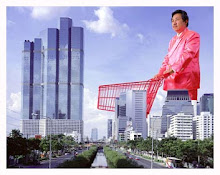
On 27th June I emailed responses to three questions from Bloomberg News about the pending election.
1. What's at stake for the military/monarchy in this election?
This is the election in which fundamental decisions about Thailand's future will have to be made. I do not mean by that the electoral choices of the Thai people which have long been subverted even before the 2006 coup, but how the incumbent royalist and militarist elite will react to the electorate's choice and, conversely, what strategies the pro-Thaksin counter elite will employ.
The key question should the Democrat Party not have sufficient numbers to form a coalition government, is whether its backers in the anti-Thaksin establishment will remain in denial about the recurrent rejection they face at the ballot box. This is a possibility. Should they choose that path, no doubt with splits along the way, they know that more violence will follow. The military-on-military and militia violence witnessed during April-May last year may return with greater intensity. So, it's a high cost strategy, so high its protagonists may not win over the less hawkish elements.
Undoubtedly, there will be some brinkmanship, as those most committed to the 2006 coup hold to the hope their long denied objectives of breaking Thaksin forces can still be executed. But the last five years prove otherwise, and they now confront a mobilised movement with depth well beyond anyone imagined. My guess is that even though there are elements willing to go for broke, the exhausting toll of the last five years weighs very heavily on those who rode with the coupsters, but who are dismayed by the securitisation of Thailand's politics and the repositioning of hardline military and royalist elements. The highly corrupt and repressive nature of elements of the current Thai regime, by which I different forces that are articulated to the state apparatuses not just the government, is not what they wished for when they tacitly supported the coup. They really did envisage an elite liberal outcome. But they bought into a logic of decisionist politics which meant embracing highly repressive politics rather than abiding by constitutional niceties, in order to to defeat a perceived enemy. But that repressiveness has almost become a norm, not the exception. These fellow travellers of the 2006 coup might be eating humble pie and make a conditional deal. Thaksin for his part will be happy to oblige. Bringing some kind of settlement together in the form of a smooth transition will be extremely difficult. At the same time, there might be an alliance of convenience among the authoritarians in both camps. Thus, think of the future as one of further mutations and splits.
2. What would a win for Pheu Thai mean for the establishment that backed the coup? What is the likelihood that Pheu Thai will be able to govern?
There is certainly a chance that Pheu Thai may have the numbers to form government in coalition. Such a prospect, for the anti Thaksin forces will be a loss of face, and will threaten their existing position. For some of them it will mean permanent marginalisation from the centres of political life. Thaksin is an astute coalition builder and one can expect that in the event of a Pheu Thai government being formed, the chairs will quickly be rearranged and space made available to everyone who plays the new game. But some soft payback can be expected; it will also be a time for the upper echelons to consider retirement. The other option facing the incumbent forces - to fight a Pheu Thai victory - would mean buying into a genuine rewriting of Thailand's constitutional settlement well beyond the electoral democracy it still adheres to (notwithstanding recent retreats). The charade of the Peoples Alliance for Democracy's "new politics" , of limiting the number of elected MPS and moving towards a form of selectocracy might be one outcome. Even though it has looked like a fanatical reactionary fringe stoking up war and hatred for the last year, the seemingly anti-political agenda of "new politics" has powerful backers, who are waiting for an opportune moment.
So, oddly, Thailand may face a situation in which the western-oriented royalist establishment, by refusing to accept a Pheu Thai victory, faces up to its failure to win in the game of elite liberal democracy by abandoning the facade of democracy and move towards a more transparently authoritarian politics.
Alternatively, should Thaksin finally emerge triumphant (and I see this as the long term scenario) you would have a government claiming a democratic mandate pursuing a look East and South policy, and merging populist rhetoric with authoritarian structures. Either prospect looks disturbing if your interest is in genuine democracy.
As for the movement of the United Front for Democracy Against Dictatorship, the redshirts, will it be able to hold any new pro-Thaksin government to democratic standards? The sad fact is that for all its shedding light on double standards and political hypocrisy, it has only done so selectively. When will the UDD publicly be honest about the authoritarian nature of the Thaksin years?
That said, we can not discount the possibility that a Pheu Thai victory will reluctantly be accepted, and new energies will be put into using constitutional avenues (sanctioned by the 2007 military sponsored constitution) and political strategies to fight Thaksin at the next election. Such an extraordinary outcome would mean a public return of democracy, while various machinations take place behind the scenes. That is what most democracies amount to these days.
3. What are the prospects of a power-sharing arrangement between Thaksin and his opponents?
Apart from hardline elements who mistakenly view Thaksin as the nadir of monarchist Thailand, my guess is the economic and political costs of protracted conflict is now weighing heavily on some of the incumbents who still want to steer Thailand to a prosperous and modern future. There must be considerable distress felt in royalist circles at the anti-royalist feeling that is emerging among rank and file redshirts and frankly the only genuine way to stop this growing is by bringing Thaksin back into the fold. Thaksin has time and time again shown his willingness to abide by most public protocols in relation to the monarchy. The inane propaganda efforts of the various security agencies are a lesson in blowback and the stupidity of force feeding people with "correct ideas". The more men in khaki wax lyrical about the royal family the more their standing is diminished. Thaksin has always signalled his willingness to do a deal and moreover is happy to deploy royalist imagery. This is what he offers and no one else can play this card. This will be the basis of any power-sharing arrangement.
In some senses the stark choice facing the rival camps is continued conflict at the cost of mutual destruction and seeing Thailand meltdown, or some step back from this and working out a formula for power sharing or at the very least a situation in which a "loyal opposition" has a credible chance of electoral victory at the following election. And should something be "agreed" this raises another question, how would such a historic anti-climax be received among those mobilised yellow and red -shirted citizens. This takes us to the final of the many unknowns of the post election period: the potential of a rising democratic mass in the face of this intra-elite bargaining and game-playing. Of all the possible game changers, this seems the least unlikely on the balance of probabilities. I'd like to be proven wrong.
July 4, 2011
April 16, 2011
Truth on Trial in Thailand: Defamation, Treason and Lèse-majesté.
The following is a review of David Streckfuss' new book Truth on Trial in Thailand: Defamation, Treason and Lèse-majesté. London: Routledge, 2011.
Full Version Available at http://criticalasianstudies.org/issues/vol43/no1/truth-on-trial-in-thailand.html
David Streckfuss's Truth on Trial in Thailand: Defamation, Treason and Lese majeste builds on what was already an extraordinarily accomplished PhD dissertation taken at Wisconsin-Madison (1998) under the supervision of Alfred McCoy and Thongchai Winichakul. The original material has been revised and expanded in the context of Thailand's regime-shaking struggles since the 2006 coup d'etat that felled Thaksin Shinawatra and the accompanying excess of defamation and lse-majest claims. Truth in Thailand is also marked by the author's recent engagement with the theorists of the “state of exception,” Carl Schmitt and Giorgio Agamben.1
It is with Agamben and Schmitt that Streckfuss can claim that Thailand's legalization of “abnormal times” since the 1950s entails a permanent suspension of constitutional order—or a state of exception in which sovereign power defines the possible. The ghost of Foucault is also present, though more as a disposition than an explicitly referenced master. Introduced briefly on the matter of “regimes of truth” (43-47), Foucault then largely fades from view, but the idea of productive discourse shadows the entire book. How could it be otherwise when Streckfuss aims to make sense of the order of things—of Thai-ness, of monarchy, and of nation, and the power that works through them?
Streckfuss thinks through these matters with ruthless clarity. Under his scholarly scrutiny the way in which Thai law has regulated the “characterisation of things” across a dispiriting one hundred years is laid bare. Central to this project has been what Streckfuss calls the “defamation regime”: “a social and political formation that over time develops a kind of 'defamation thinking' and 'impulse' that focuses on the insult of the defamatory statement, often at the expense of the truth” (xv). His expert narrative shows how courts, inspired by wider state discourses, try to establish the intent of those who have allegedly defamed the nation, the monarchy, or Thai-ness—and in so doing make visible the logic of the regime's self-image. In shining a spotlight on these legal moments Streckfuss is illuminating the underlying collective logic by which power has been consolidated in Thailand.
The book's thirteen chapters are rich in detail and observation, and many Old Thai Hands will learn much from each of them. Thematically organized, the chapters offer an incomparable history of lse-majest, law and Thai-ness, public opinion, and the science of traitorology. Of especial relevance given the recent discussion of the judicialization of politics in Thailand is Streckfuss's remarkable account in chapter 5 of the institutionalization of the “state of exception” by Thai courts working in conjunction with the police and military. Tracing the use of “indistinct, legal concepts such as 'peace and order' or 'threat to national security'” (113) and working through court transcripts, Streckfuss shows the essential reasoning behind the constitutional standing of the hundreds of coup decrees that have the status of law. No one hoping to understand the hybrid nature of Thailand's authoritarian-liberal mix can ignore this chapter, even if some (including me) will take exception to his argument that the country has been in varying states of exception for decades. Even if technically correct in the sense that extra-constitutional acts found Thai political order and shadow it—and that such acts announce themselves with disturbing frequency—the idea of a permanent “state of exception” can lead to overgeneralization. It can gloss, for example, Thailand's shifting regime forms since the 1950s and the differential relationship each has to law.
Many readers will be intrigued by Streckfuss's attempt to explain with Buddhist logic the actions that precede and follow coups d'etat, more than ten of which Thailand has witnessed since 1932. He writes:
This pattern [of a coup d'etat and self-issued amnesty and constitution] seems inexplicable unless we look at the practise as ritual purification—a public act certified by Thai Theravada Buddhism that recognizes a sacrifice (staging a coup), acknowledges a necessary murder (the killing of a constitution), and rewards giving (a new constitution, a new political order). (122)
Some might read as overly culturalist this account of coups d'etat as purification rituals that establish the pure intent of their protagonists (following a Buddhist inclination to stress right intent). At the very least the argument is provocative and offers original insights that expand our ways of thinking through the cultural aspects of Thai politics. Indeed, those hoping to understand the thinking of the Thai establishment and its social intermediaries may well feel they can finally name what has been hitherto a vague sense of Thai elite mentality. Streckfuss's desire to understand, and his dedicated patience in doing so, allows him to render visible the authenticity of a conservative Thai worldview that is often forgotten or cynically understood as mere venal interest. In short, Streckfuss has captured, on a political rather than aesthetic register, what Raymond Williams calls a “structure of feeling” and its practical consciousness.2 This is what Streckfuss means when he speaks of a “defamation regime.”
It remains to be said that if a certain ironical grin accompanies Streckfuss's extensive and persuasive documentation of the defamation regime, present also is horror at the human cost that this regime extracts. Such sentiment hints at the deep humanism that drives his scholarship. No one can read the book's last page on the “Ghosts of Forgotten History,” reminiscent of Walter Benjamin's portrayal of the Angel of Progress, and not shudder at the thought of future Thai troubles on the way to democracy. When the “'Ghosts' of the Duson-nyor massacre, 6 October, Black May, and Tak Bai” (315) are finally granted an audience, Thailand will not be the same.
This monumental volume is destined to take a leading place in the field of critical studies of Asia.
The review appears in the: Connors MK and Streckfuss, D (2011) 'Michael K. Connors in conversation with David Streckfuss, author of Truth on Trial in Thailand', Critical Asian Studies, 43:1, 139 - 149
Full Version Available at http://criticalasianstudies.org/issues/vol43/no1/truth-on-trial-in-thailand.html
David Streckfuss's Truth on Trial in Thailand: Defamation, Treason and Lese majeste builds on what was already an extraordinarily accomplished PhD dissertation taken at Wisconsin-Madison (1998) under the supervision of Alfred McCoy and Thongchai Winichakul. The original material has been revised and expanded in the context of Thailand's regime-shaking struggles since the 2006 coup d'etat that felled Thaksin Shinawatra and the accompanying excess of defamation and lse-majest claims. Truth in Thailand is also marked by the author's recent engagement with the theorists of the “state of exception,” Carl Schmitt and Giorgio Agamben.1
It is with Agamben and Schmitt that Streckfuss can claim that Thailand's legalization of “abnormal times” since the 1950s entails a permanent suspension of constitutional order—or a state of exception in which sovereign power defines the possible. The ghost of Foucault is also present, though more as a disposition than an explicitly referenced master. Introduced briefly on the matter of “regimes of truth” (43-47), Foucault then largely fades from view, but the idea of productive discourse shadows the entire book. How could it be otherwise when Streckfuss aims to make sense of the order of things—of Thai-ness, of monarchy, and of nation, and the power that works through them?
Streckfuss thinks through these matters with ruthless clarity. Under his scholarly scrutiny the way in which Thai law has regulated the “characterisation of things” across a dispiriting one hundred years is laid bare. Central to this project has been what Streckfuss calls the “defamation regime”: “a social and political formation that over time develops a kind of 'defamation thinking' and 'impulse' that focuses on the insult of the defamatory statement, often at the expense of the truth” (xv). His expert narrative shows how courts, inspired by wider state discourses, try to establish the intent of those who have allegedly defamed the nation, the monarchy, or Thai-ness—and in so doing make visible the logic of the regime's self-image. In shining a spotlight on these legal moments Streckfuss is illuminating the underlying collective logic by which power has been consolidated in Thailand.
The book's thirteen chapters are rich in detail and observation, and many Old Thai Hands will learn much from each of them. Thematically organized, the chapters offer an incomparable history of lse-majest, law and Thai-ness, public opinion, and the science of traitorology. Of especial relevance given the recent discussion of the judicialization of politics in Thailand is Streckfuss's remarkable account in chapter 5 of the institutionalization of the “state of exception” by Thai courts working in conjunction with the police and military. Tracing the use of “indistinct, legal concepts such as 'peace and order' or 'threat to national security'” (113) and working through court transcripts, Streckfuss shows the essential reasoning behind the constitutional standing of the hundreds of coup decrees that have the status of law. No one hoping to understand the hybrid nature of Thailand's authoritarian-liberal mix can ignore this chapter, even if some (including me) will take exception to his argument that the country has been in varying states of exception for decades. Even if technically correct in the sense that extra-constitutional acts found Thai political order and shadow it—and that such acts announce themselves with disturbing frequency—the idea of a permanent “state of exception” can lead to overgeneralization. It can gloss, for example, Thailand's shifting regime forms since the 1950s and the differential relationship each has to law.
Many readers will be intrigued by Streckfuss's attempt to explain with Buddhist logic the actions that precede and follow coups d'etat, more than ten of which Thailand has witnessed since 1932. He writes:
This pattern [of a coup d'etat and self-issued amnesty and constitution] seems inexplicable unless we look at the practise as ritual purification—a public act certified by Thai Theravada Buddhism that recognizes a sacrifice (staging a coup), acknowledges a necessary murder (the killing of a constitution), and rewards giving (a new constitution, a new political order). (122)
Some might read as overly culturalist this account of coups d'etat as purification rituals that establish the pure intent of their protagonists (following a Buddhist inclination to stress right intent). At the very least the argument is provocative and offers original insights that expand our ways of thinking through the cultural aspects of Thai politics. Indeed, those hoping to understand the thinking of the Thai establishment and its social intermediaries may well feel they can finally name what has been hitherto a vague sense of Thai elite mentality. Streckfuss's desire to understand, and his dedicated patience in doing so, allows him to render visible the authenticity of a conservative Thai worldview that is often forgotten or cynically understood as mere venal interest. In short, Streckfuss has captured, on a political rather than aesthetic register, what Raymond Williams calls a “structure of feeling” and its practical consciousness.2 This is what Streckfuss means when he speaks of a “defamation regime.”
It remains to be said that if a certain ironical grin accompanies Streckfuss's extensive and persuasive documentation of the defamation regime, present also is horror at the human cost that this regime extracts. Such sentiment hints at the deep humanism that drives his scholarship. No one can read the book's last page on the “Ghosts of Forgotten History,” reminiscent of Walter Benjamin's portrayal of the Angel of Progress, and not shudder at the thought of future Thai troubles on the way to democracy. When the “'Ghosts' of the Duson-nyor massacre, 6 October, Black May, and Tak Bai” (315) are finally granted an audience, Thailand will not be the same.
This monumental volume is destined to take a leading place in the field of critical studies of Asia.
The review appears in the: Connors MK and Streckfuss, D (2011) 'Michael K. Connors in conversation with David Streckfuss, author of Truth on Trial in Thailand', Critical Asian Studies, 43:1, 139 - 149

January 8, 2011
Notes Towards an Understanding of Thai liberalism
"Notes Towards an Understanding of Thai liberalism"
Michael K. Connors
forthcoming in Bangkok, May 2010: Perspectives on a Divided Thailand. Singapore: Institute of Southeast Asian Studies (ISEAS) edited by Mike Montesano, Pavin Chachavalpongpun and Aekapol Chongvilaivan.
(parts of this piece have previously appeared in The Age and this blog)
It is easy to understand the plausibility of the case that the principal struggle unfolding in Thailand today pits democracy against authoritarianism. The events of the past four years seem to speak for themselves: the 2006 coup against the ‘pro-poor’ Thaksin government, the manipulated pro-military constitutional referendum of 2007, the judicial dissolution of the Thai Rak Thai (2007) and its successor People’s Power (2008) parties, and the subsequent military-supported installation of a Democrat-led coalition government in late 2008. Then of course comes the spilling of blood that feeds the democracy-authoritarianism narrative: the bloody crackdown in April – May 2010 against Red Shirt protestors and the imposition of a draconian state of emergency, human rights violations, and the suspension of due process for hundreds of political detainees.
The "democratic versus authoritarian” narrative, connected to the idea of a popular struggle against a rich establishment, has captured international attention. It is also at the heart of the self-presentation of the United Front for Democracy Against Dictatorship (UDD), so brilliantly exemplified by the etching of the world phrai (commoner) onto red tee-shirts. There are elements of truth in this formulation. But the same general tension – democracy versus authoritarianism – could just as easily substitute for a short history of human society, with one problem: it explains everything generally, but nothing particularly. In recent times the formulation has led to skewed analysis of Thailand’s crisis, and to a cheer-squad mentality that fails to capture intra-class/state conflict and inter-class/state agency cooperation. It obscures the nature of Thailand’s recent past and its likely trajectory. Moving beyond such a simplistic analysis makes possible a more serious probing of the specific nature of the conflict and of the possibilities for its resolution. Early-twentieth-century Marxist Antonio Gramsci offers the best argument against simplistic representation: "A given socio-historical moment is never homogeneous; on the contrary, it is rich in contradictions." To understand Thailand’s rich contradictions, it is better to drop the catch-all explanation and to come to grips with the specificity of the crisis at hand.
These notes toward an understanding of Thai liberalism are, I suppose, an uncomfortable call for observers to stand at some intellectual distance from the daily malaise of democracy in Thailand and to seek more sensitive lenses through which to examine both the interests and ideologies behind the competing claims of now fundamentally antagonistic elites, and the popular bases with which these interests and ideologies are articulated.
While rich in contradiction, the Thai context nevertheless has a dominant dynamic. That dynamic includes the largely unexplained pacting during 2005 and 2006 of statist conservatives and elite liberals against the emergent and competitive authoritarianism represented by Thaksin Shinawatra. It also includes the re-pacting of those same elements upon the emergence of the Red Shirt movement (itself composed of some liberal elements).
I say “unexplained” because, for the most part, political liberalism in Thailand is not taken seriously by analysts. It is seen as rhetorical and mealy-mouthed. When it is recognised, it is viewed as having been eclipsed by the instrumental politics of competing networks. There is thus nothing to explain. Scratch a political liberal in Thailand, and underneath is a snivelling courtier ready to serve monarchy, military and bureaucracy, or any paymaster – or so it is claimed. This view of Thai elites holds that ideas and social projects do not matter; only venal interest are deemed relevant. The view also broadly endorses a conspiratorial understanding of politics. This understanding has it that a monolithic elite self-consciously acts as the puppet master in all matters. This view does not recognize the fragmented and hostile relations between liberals and conservatives, because it takes Thai liberals and conservatives to be, fundamentally, one and the same.
At another level, a number of non-governmental organizations, activists and public intellectuals have taken a non-antagonistic, if not sympathetic, position to the anti-Thaksin side. Arguably, this position makes these groups and individuals distantly complicit in the authoritarian resolution to the crisis. But, just as differences between liberals and statists are elided in the conventional narrative, so too are those between elite liberalism and the social liberalism espoused by Thailand’s NGOs. NGOs’ failure to rally to the Red Shirts leads critics to bundle them together as part of the amaat (the bureaucratic-aristocratic establishment), as if those who have struggled for social justice over the last generation have suddenly become concerned only with their own interests and those of Thai elites. By the force of this logic, those who do not side with the Red Shirts are merely morally defective and opportunistic.
A morally charged critique based on the alleged defective character of those with whom one disagrees does not advance understanding of different strategic positions. Rather, it leaves one in the realm of puppet play, of good and evil, and of caricature. It results in accounts lacking in explanatory power, their rhetorical force notwithstanding.
Illumination of the contradiction of Thai liberalism’s pact with statist conservatism, only one of many pacts now in operation, requires an answer to one crucial question: why was Thaksin deposed? The answer is clear: Thaksin threatened a tentative liberal-conservative pact, one that emerged in the 1990s, on sharing power. The pact put Thailand on a trajectory toward a more liberal democratic polity. A variety of social forces, their interests differentially entangled in that project, mobilised against Thaksin. This mobilisation culminated in the September 2006 coup d’état. Subsequent developments have certainly transformed the nature of the struggle from an intra-elite contest to a broader societal conflict.
Confronting the transformation of the pro-Thaksin side into a messily conjoined quasi-popular/counter-elite movement advancing egalitarian positions, the liberal-conservative pact has hardened. The “soft coup” of 2006 has become a distant memory.
In this moment of profound structural crisis, Prime Minister Abhisit Vejjajiva symbolises the liberal pact with statist conservatives. His government’s maintenance throughout 2010 of the Emergency Decree invoked in April 2010 subsequent to the crushing of the Red Shirt rebellion reveals the foundations of sovereign power in force. But this is not naked power, even if it is abusive. Its purported aim is to prepare the ground for the realization of liberalism’s preferred state form in the post-crisis period. Such is Thai liberalism’s current internal logic and public message: judge us not by situational logic and actions, but by our long-term project, to which we now turn.
After the February 1991 coup – an attempt by statists and conservatives to roll back the emergence of a more open and democratic society - a politically liberal reform movement emerged in Thailand. Elites recognised that the semi-democracy of the 1980s was the creature of an age gone by. This movement resulted in the celebrated 1997 ''People's Constitution'', which formally enshrined liberal doctrine at the heart of the Thai state. Henceforth, executive power (rooted in a democratic mandate) would be subject to a variety of liberal checks and balances. An electoral commission and constitutional and administrative courts would scrutinise the exercise of that power. No one expected a smooth path to liberal democracy in Thailand. The military's corporate interests remained. Networks around the monarchy continued to wield power. Corruption was pervasive. The liberal project was understood to be gradual and generational.
Then the project came unstuck. While in government during the Asian economic crisis of 1997-2000, the liberally oriented Democrat Party failed to offer anything except implementation of an International Monetary Fund austerity program and the creation of a social-welfare safety valve in the form of the Social Investment Fund. Such liberal feebleness paved the way for Thaksin and his brand of authoritarian populism and ‘pro-poor’ policies.
During his term as prime minister (2001-06), Thaksin tore up the aspirational liberal settlement. His disregard for human rights and the institutions intended to subject executive power to checks and balances is well documented. So too is the level of electoral support that he enjoyed, which won him power in 2001 and 2005. His project was a modernized and globalized Thai capitalism whose midwife would be elected authoritarianism. Liberalism, such as it was, and democracy, such as it could be, parted ways.
The Yellow Shirt movement against Thaksin that arose in 2005-06 brought together liberal middle-class elements, members of the rural poor and unionists opposed to privatisation programs. It also included elite conservative elements fearful that Thaksin was pushing them out of their traditional roles as powerbrokers. These elements viewed Thaksin as a threat to the social order and, importantly, to the monarchy.
Since 2006, Thai liberals have joined with conservative elements in the state, and with the Yellow Shirts, to defeat Thaksin and his supporters. Together, they played a role in bringing down the elected pro-Thaksin governments in late 2008. They were and are driven by a flawed logic of gradually returning Thailand to something like the liberal-conservative settlement of 1997, with all of its compromises and more besides. Liberalism’s dependence on its erstwhile statist competitors in the military and bureaucracy make those additional compromises necessary.
From liberal-conservative pact to liberal authoritarianism
Two compelling fears drive Thailand’s now transformed liberal authoritarianism, by which I mean the use of authoritarian means to return Thailand to its elitist liberal trajectory.
The first is fear that an alternative modernizing network of politicians, statists, and business, under the leadership of Thaksin, and possibly with support of a new monarch, will block a return to the circumscribed but pluralistic competition for power that characterized the emergent liberal-conservative period of the 1990s to early 2000s. ). Corporate interest also drives those who would stand to lose from the end of that regime of circumscribed competition. And when self-interest finds justification in pious commitment to a visibly threatened social order – brutal action unremarkably follows. Thaksin’s modernizing authoritarianism was antagonistic to an established historical bloc whose members believed that, all things being equal, it was edging Thailand in the right direction. That bloc is not intent on establishing a Burmese-style junta, or on returning to policies of benign neglect of the poor. Should it succeed in its goals, the most likely outcome will be a partially reformed (for survival requires some degree of reform) but nevertheless elite-controlled order. Evidence for these likely goals is to be found in the way in which the Abhisit government is accelerating land reform and addressing other socio-economic grievances whilst simultaneously trying to bring political contestation under control.
A new logic is now also present, one that transcends earlier fears of populism. The roots of this second fear lie in apprehensiveness over the unleashed expectations of Thailand’s less powerful classes coupled with a relentless organizational drive to return to power by Thaksin. It is also rooted in concern over those classes’ new-found fury at the bare-faced authoritarian posture of the Abhisit government and its hardline backers in the Thai military. The very existence of armed elements in the Red Shirt camp (incredulously denied by Red Shirt sympathisers or explained away as a desperate strategy) fuels this contingent authoritarianism, and forces it to reveal itself.
In this post-coup phase, in which might is doubly right, situational logics and political choices have brought into being a reactionary societal current that gives partisan legitimacy to the government. Relief that the Red Shirts have been “dealt with” gives rise to exaltation of the “handlers.” Take as one example the adulation of Centre for Resolution of Emergency Situation spokesperson Colonel Sansern Kaewkamnerd, as in The Nation’s 30 May 2010 article “Saluting the kingdom's coolest colonel.” It is a legitimacy that rests on portraying the Red threat as criminal and terroristic, and therefore not worthy of political engagement.
The threat of social upheaval, of a world turned upside down, has brought all sorts of pathologies to the surface: witch-hunts, educational ostracism, dehumanising portrayals of those who disagree, bloodcurdling snobbery and a recapturing of the city of angels by sovereign consumers speedily spending the country out of crisis. Unsettled by the emergence of a rival state in the heartland of Bangkok during April and May of 2010, as exemplified by the imposition of Red Shirt authority on street corners and influence on sections of the state’s police and armed forces, people began to howl in mid-2010 for a political cleansing as malignantly intended as it would be destructive. Liberalism looks at itself in the mirror and wonders how it got to this state.
Thinking about liberalism as a problematic, not as a doctrine
The question arises, does what we are discussing have anything to do with liberalism? In reply, I would note that it is best to think of liberalism in general and in the Thai case in particular not simply as a philosophy of the conditions for individual autonomy, but as a response to the problems of governance in complex societies in which modern state structures emerge, power centres are plural, and conflict and public interest require regulation and adjudication to preserve defined liberties. At a minimum, liberal aspiration accords with the division and accountability of power. I am speaking more of a political than individually-centred philosophical liberalism. Liberalism, in its own way, asks, What is to be done?
What is to be done with an electorate – judged in part to be dependent and lacking in capacity because of information flows - that keeps returning to office (in 2005 and 2008) a political class that will move Thailand away from the liberal-conservative settlement of 1997? Thai liberalism is no different from historic forms of liberalism that feared the “tyranny of the majority” and the egalitarian impulse of democracy. Many liberals are disposed to support or at least condone aristocratic tutelage over citizens who need to be “developed” before they can be sovereign. It took several generations in many countries for liberalism to settle into democratic realities. It still does not quite fit, and liberals the world over must constantly deal with the populist underside of democracy and the illiberal nature of big business and the security state.
What is to be done with a political class that is highly corrupt and money-driven? Classic liberal themes of public interest, of conflict of interest, and of virtue come into play. Everywhere, liberals rally against the decline of virtue. But in its present moment, elite liberalism makes compromises and is articulated with corrupt or conservative elements “on the right side.” Its pragmatic side is a reflection of politics as the art of the possible. Think of the pragmatic alliance between the Democrat Party and its coalition partners. Presumably, virtue’s day will come.
What is to be done with the statist and conservative institutions of monarchy, military and bureaucracy, and with the networks that permeate them? Precisely because this problem deemed less serious than the Thaksinite threat, it is momentarily put aside. Should the Thaksinite and populist threat be neutralized, one may expect a return of the ongoing contest between liberal and statist conservative elements. That the peak statist element of “the network monarchy” is a gerontocracy gives the advantage to the elite liberal network.
One particular way in which liberals have sought to engage and gradually transform the monarchy is by embedding what I have called “royal liberalism”. In doing so they are re- enacting liberalism’s historical flirtation (in France and England) with monarchy as a guardian centre above “politics”, what leading Thai legal scholar Bowonsak Uwanno describes as the “the supreme ombudsman”. In that role, the crown supposedly acts as the liberal regulator, ensuring the division of power and protecting the public interest. Aside from its legitimating function, the idea of “royal liberalism” is a reforming, indeed disciplining discourse directed at the Thai monarchy and at those who mobilize the institution for illiberal purposes. It is a claim on the monarchy as a public institution. The aspiration for liberal monarchy is challenged by the reputed relationship between Thaksin and the Crown Prince. That relationship would raise the spectre of a weakened “ombudsman”, and a directly politicised monarchy. Of course, the status of the current “ombudsman” is not up for discussion among Thai liberals. This is one limit, among many others, of Thai liberalism.
What is to be done to bring future stability and to secure a political settlement? Here the liberal impulse is strongly evident in the habitual selection of two prominent royalists, Anand Panyarachun and Prawet Wasi, to head government-sponsored reform and reconciliation committees. The re-emergence of organic intellectuals of the emergent liberal state of the 1990s, after several years of effective silence, to spear-head the Abhisit government’s reconciliation plan comes just when liberalism’s pact with state authority is at its apex and there exists a supra- state of exception. Nevertheless, and to repeat, while some predict a lurch toward Burma-like scenario and military ascendancy, the evidence suggests a return at some point to the elite liberal politics of the 1990s accompanied and diminished by strengthened military corporatism. Such permutations are the stuff of history.
I am suggesting that, despite the rupture of the 2006 coup, a great deal of continuity links 1992 to 2010 – something evident in the content of the 2007 constitution, notwithstanding its roll-back in some important areas. It is easy to label politics after May 2010 as laden with fascist intent and practise, but the charge hardly makes sense if one considers historic forms of fascism. Moreover, sloganeering and misdiagnosis preclude the development of a progressive strategy to take advantage of the opportunities provided by the existing contradictory situation.
It is necessary to come to terms with Thailand’s liberal tendencies, however unhandsomely Thai liberalism enters into pacts with authoritarianism in moments of crisis and with conservative social traditions as part of its commitment to nation-building. The contention that the current authoritarian phase in Bangkok’s politics makes liberalism all but redundant betrays an unfamiliarity with liberalism as a problem solving orientation as much as a series of principles, and with its history of siding with order over disorder. It is a history that has involved, for example, a certain fondness for Bismarck, a recognition of monarchy, and an aristocratic disposition masquerading as virtuous citizenship. Liberal problematics and discourses are not simply an iterance of settled doctrine. Rather, they are unique expressions of an endeavour for openness in the prevailing power relations specific to a given society at a given time. Thai elite liberalism resonates with historical forms of what Alan Kahan calls “aristocratic liberalism”.
Thai liberalism may be wrong in its strategic readings of the balance of power, opportunistic in its pacting, and elitist in its assumption of guardianship. But it is in its stated ambition a form of liberalism, however diminished and enfeebled. When Abhisit proclaims himself a political liberal, I believe him.
Prerogative rule by the executive in extraordinary times is not a concept alien to the liberal tradition. But such rule does bring an obligation for authoritarian liberalism to make clear how, if at all, its actions will return politics to a liberal democratic pathway. At the moment of writing, this is the paramount problematic facing the Abhisit government.
Michael K. Connors teaches politics in the School of Social Sciences, La Trobe University.
Sources available in the forthcoming hardcopy.
_____________________________________________________
This piece was written in August 2010.
Michael K. Connors
forthcoming in Bangkok, May 2010: Perspectives on a Divided Thailand. Singapore: Institute of Southeast Asian Studies (ISEAS) edited by Mike Montesano, Pavin Chachavalpongpun and Aekapol Chongvilaivan.
(parts of this piece have previously appeared in The Age and this blog)
It is easy to understand the plausibility of the case that the principal struggle unfolding in Thailand today pits democracy against authoritarianism. The events of the past four years seem to speak for themselves: the 2006 coup against the ‘pro-poor’ Thaksin government, the manipulated pro-military constitutional referendum of 2007, the judicial dissolution of the Thai Rak Thai (2007) and its successor People’s Power (2008) parties, and the subsequent military-supported installation of a Democrat-led coalition government in late 2008. Then of course comes the spilling of blood that feeds the democracy-authoritarianism narrative: the bloody crackdown in April – May 2010 against Red Shirt protestors and the imposition of a draconian state of emergency, human rights violations, and the suspension of due process for hundreds of political detainees.
The "democratic versus authoritarian” narrative, connected to the idea of a popular struggle against a rich establishment, has captured international attention. It is also at the heart of the self-presentation of the United Front for Democracy Against Dictatorship (UDD), so brilliantly exemplified by the etching of the world phrai (commoner) onto red tee-shirts. There are elements of truth in this formulation. But the same general tension – democracy versus authoritarianism – could just as easily substitute for a short history of human society, with one problem: it explains everything generally, but nothing particularly. In recent times the formulation has led to skewed analysis of Thailand’s crisis, and to a cheer-squad mentality that fails to capture intra-class/state conflict and inter-class/state agency cooperation. It obscures the nature of Thailand’s recent past and its likely trajectory. Moving beyond such a simplistic analysis makes possible a more serious probing of the specific nature of the conflict and of the possibilities for its resolution. Early-twentieth-century Marxist Antonio Gramsci offers the best argument against simplistic representation: "A given socio-historical moment is never homogeneous; on the contrary, it is rich in contradictions." To understand Thailand’s rich contradictions, it is better to drop the catch-all explanation and to come to grips with the specificity of the crisis at hand.
These notes toward an understanding of Thai liberalism are, I suppose, an uncomfortable call for observers to stand at some intellectual distance from the daily malaise of democracy in Thailand and to seek more sensitive lenses through which to examine both the interests and ideologies behind the competing claims of now fundamentally antagonistic elites, and the popular bases with which these interests and ideologies are articulated.
While rich in contradiction, the Thai context nevertheless has a dominant dynamic. That dynamic includes the largely unexplained pacting during 2005 and 2006 of statist conservatives and elite liberals against the emergent and competitive authoritarianism represented by Thaksin Shinawatra. It also includes the re-pacting of those same elements upon the emergence of the Red Shirt movement (itself composed of some liberal elements).
I say “unexplained” because, for the most part, political liberalism in Thailand is not taken seriously by analysts. It is seen as rhetorical and mealy-mouthed. When it is recognised, it is viewed as having been eclipsed by the instrumental politics of competing networks. There is thus nothing to explain. Scratch a political liberal in Thailand, and underneath is a snivelling courtier ready to serve monarchy, military and bureaucracy, or any paymaster – or so it is claimed. This view of Thai elites holds that ideas and social projects do not matter; only venal interest are deemed relevant. The view also broadly endorses a conspiratorial understanding of politics. This understanding has it that a monolithic elite self-consciously acts as the puppet master in all matters. This view does not recognize the fragmented and hostile relations between liberals and conservatives, because it takes Thai liberals and conservatives to be, fundamentally, one and the same.
At another level, a number of non-governmental organizations, activists and public intellectuals have taken a non-antagonistic, if not sympathetic, position to the anti-Thaksin side. Arguably, this position makes these groups and individuals distantly complicit in the authoritarian resolution to the crisis. But, just as differences between liberals and statists are elided in the conventional narrative, so too are those between elite liberalism and the social liberalism espoused by Thailand’s NGOs. NGOs’ failure to rally to the Red Shirts leads critics to bundle them together as part of the amaat (the bureaucratic-aristocratic establishment), as if those who have struggled for social justice over the last generation have suddenly become concerned only with their own interests and those of Thai elites. By the force of this logic, those who do not side with the Red Shirts are merely morally defective and opportunistic.
A morally charged critique based on the alleged defective character of those with whom one disagrees does not advance understanding of different strategic positions. Rather, it leaves one in the realm of puppet play, of good and evil, and of caricature. It results in accounts lacking in explanatory power, their rhetorical force notwithstanding.
Illumination of the contradiction of Thai liberalism’s pact with statist conservatism, only one of many pacts now in operation, requires an answer to one crucial question: why was Thaksin deposed? The answer is clear: Thaksin threatened a tentative liberal-conservative pact, one that emerged in the 1990s, on sharing power. The pact put Thailand on a trajectory toward a more liberal democratic polity. A variety of social forces, their interests differentially entangled in that project, mobilised against Thaksin. This mobilisation culminated in the September 2006 coup d’état. Subsequent developments have certainly transformed the nature of the struggle from an intra-elite contest to a broader societal conflict.
Confronting the transformation of the pro-Thaksin side into a messily conjoined quasi-popular/counter-elite movement advancing egalitarian positions, the liberal-conservative pact has hardened. The “soft coup” of 2006 has become a distant memory.
In this moment of profound structural crisis, Prime Minister Abhisit Vejjajiva symbolises the liberal pact with statist conservatives. His government’s maintenance throughout 2010 of the Emergency Decree invoked in April 2010 subsequent to the crushing of the Red Shirt rebellion reveals the foundations of sovereign power in force. But this is not naked power, even if it is abusive. Its purported aim is to prepare the ground for the realization of liberalism’s preferred state form in the post-crisis period. Such is Thai liberalism’s current internal logic and public message: judge us not by situational logic and actions, but by our long-term project, to which we now turn.
After the February 1991 coup – an attempt by statists and conservatives to roll back the emergence of a more open and democratic society - a politically liberal reform movement emerged in Thailand. Elites recognised that the semi-democracy of the 1980s was the creature of an age gone by. This movement resulted in the celebrated 1997 ''People's Constitution'', which formally enshrined liberal doctrine at the heart of the Thai state. Henceforth, executive power (rooted in a democratic mandate) would be subject to a variety of liberal checks and balances. An electoral commission and constitutional and administrative courts would scrutinise the exercise of that power. No one expected a smooth path to liberal democracy in Thailand. The military's corporate interests remained. Networks around the monarchy continued to wield power. Corruption was pervasive. The liberal project was understood to be gradual and generational.
Then the project came unstuck. While in government during the Asian economic crisis of 1997-2000, the liberally oriented Democrat Party failed to offer anything except implementation of an International Monetary Fund austerity program and the creation of a social-welfare safety valve in the form of the Social Investment Fund. Such liberal feebleness paved the way for Thaksin and his brand of authoritarian populism and ‘pro-poor’ policies.
During his term as prime minister (2001-06), Thaksin tore up the aspirational liberal settlement. His disregard for human rights and the institutions intended to subject executive power to checks and balances is well documented. So too is the level of electoral support that he enjoyed, which won him power in 2001 and 2005. His project was a modernized and globalized Thai capitalism whose midwife would be elected authoritarianism. Liberalism, such as it was, and democracy, such as it could be, parted ways.
The Yellow Shirt movement against Thaksin that arose in 2005-06 brought together liberal middle-class elements, members of the rural poor and unionists opposed to privatisation programs. It also included elite conservative elements fearful that Thaksin was pushing them out of their traditional roles as powerbrokers. These elements viewed Thaksin as a threat to the social order and, importantly, to the monarchy.
Since 2006, Thai liberals have joined with conservative elements in the state, and with the Yellow Shirts, to defeat Thaksin and his supporters. Together, they played a role in bringing down the elected pro-Thaksin governments in late 2008. They were and are driven by a flawed logic of gradually returning Thailand to something like the liberal-conservative settlement of 1997, with all of its compromises and more besides. Liberalism’s dependence on its erstwhile statist competitors in the military and bureaucracy make those additional compromises necessary.
From liberal-conservative pact to liberal authoritarianism
Two compelling fears drive Thailand’s now transformed liberal authoritarianism, by which I mean the use of authoritarian means to return Thailand to its elitist liberal trajectory.
The first is fear that an alternative modernizing network of politicians, statists, and business, under the leadership of Thaksin, and possibly with support of a new monarch, will block a return to the circumscribed but pluralistic competition for power that characterized the emergent liberal-conservative period of the 1990s to early 2000s. ). Corporate interest also drives those who would stand to lose from the end of that regime of circumscribed competition. And when self-interest finds justification in pious commitment to a visibly threatened social order – brutal action unremarkably follows. Thaksin’s modernizing authoritarianism was antagonistic to an established historical bloc whose members believed that, all things being equal, it was edging Thailand in the right direction. That bloc is not intent on establishing a Burmese-style junta, or on returning to policies of benign neglect of the poor. Should it succeed in its goals, the most likely outcome will be a partially reformed (for survival requires some degree of reform) but nevertheless elite-controlled order. Evidence for these likely goals is to be found in the way in which the Abhisit government is accelerating land reform and addressing other socio-economic grievances whilst simultaneously trying to bring political contestation under control.
A new logic is now also present, one that transcends earlier fears of populism. The roots of this second fear lie in apprehensiveness over the unleashed expectations of Thailand’s less powerful classes coupled with a relentless organizational drive to return to power by Thaksin. It is also rooted in concern over those classes’ new-found fury at the bare-faced authoritarian posture of the Abhisit government and its hardline backers in the Thai military. The very existence of armed elements in the Red Shirt camp (incredulously denied by Red Shirt sympathisers or explained away as a desperate strategy) fuels this contingent authoritarianism, and forces it to reveal itself.
In this post-coup phase, in which might is doubly right, situational logics and political choices have brought into being a reactionary societal current that gives partisan legitimacy to the government. Relief that the Red Shirts have been “dealt with” gives rise to exaltation of the “handlers.” Take as one example the adulation of Centre for Resolution of Emergency Situation spokesperson Colonel Sansern Kaewkamnerd, as in The Nation’s 30 May 2010 article “Saluting the kingdom's coolest colonel.” It is a legitimacy that rests on portraying the Red threat as criminal and terroristic, and therefore not worthy of political engagement.
The threat of social upheaval, of a world turned upside down, has brought all sorts of pathologies to the surface: witch-hunts, educational ostracism, dehumanising portrayals of those who disagree, bloodcurdling snobbery and a recapturing of the city of angels by sovereign consumers speedily spending the country out of crisis. Unsettled by the emergence of a rival state in the heartland of Bangkok during April and May of 2010, as exemplified by the imposition of Red Shirt authority on street corners and influence on sections of the state’s police and armed forces, people began to howl in mid-2010 for a political cleansing as malignantly intended as it would be destructive. Liberalism looks at itself in the mirror and wonders how it got to this state.
Thinking about liberalism as a problematic, not as a doctrine
The question arises, does what we are discussing have anything to do with liberalism? In reply, I would note that it is best to think of liberalism in general and in the Thai case in particular not simply as a philosophy of the conditions for individual autonomy, but as a response to the problems of governance in complex societies in which modern state structures emerge, power centres are plural, and conflict and public interest require regulation and adjudication to preserve defined liberties. At a minimum, liberal aspiration accords with the division and accountability of power. I am speaking more of a political than individually-centred philosophical liberalism. Liberalism, in its own way, asks, What is to be done?
What is to be done with an electorate – judged in part to be dependent and lacking in capacity because of information flows - that keeps returning to office (in 2005 and 2008) a political class that will move Thailand away from the liberal-conservative settlement of 1997? Thai liberalism is no different from historic forms of liberalism that feared the “tyranny of the majority” and the egalitarian impulse of democracy. Many liberals are disposed to support or at least condone aristocratic tutelage over citizens who need to be “developed” before they can be sovereign. It took several generations in many countries for liberalism to settle into democratic realities. It still does not quite fit, and liberals the world over must constantly deal with the populist underside of democracy and the illiberal nature of big business and the security state.
What is to be done with a political class that is highly corrupt and money-driven? Classic liberal themes of public interest, of conflict of interest, and of virtue come into play. Everywhere, liberals rally against the decline of virtue. But in its present moment, elite liberalism makes compromises and is articulated with corrupt or conservative elements “on the right side.” Its pragmatic side is a reflection of politics as the art of the possible. Think of the pragmatic alliance between the Democrat Party and its coalition partners. Presumably, virtue’s day will come.
What is to be done with the statist and conservative institutions of monarchy, military and bureaucracy, and with the networks that permeate them? Precisely because this problem deemed less serious than the Thaksinite threat, it is momentarily put aside. Should the Thaksinite and populist threat be neutralized, one may expect a return of the ongoing contest between liberal and statist conservative elements. That the peak statist element of “the network monarchy” is a gerontocracy gives the advantage to the elite liberal network.
One particular way in which liberals have sought to engage and gradually transform the monarchy is by embedding what I have called “royal liberalism”. In doing so they are re- enacting liberalism’s historical flirtation (in France and England) with monarchy as a guardian centre above “politics”, what leading Thai legal scholar Bowonsak Uwanno describes as the “the supreme ombudsman”. In that role, the crown supposedly acts as the liberal regulator, ensuring the division of power and protecting the public interest. Aside from its legitimating function, the idea of “royal liberalism” is a reforming, indeed disciplining discourse directed at the Thai monarchy and at those who mobilize the institution for illiberal purposes. It is a claim on the monarchy as a public institution. The aspiration for liberal monarchy is challenged by the reputed relationship between Thaksin and the Crown Prince. That relationship would raise the spectre of a weakened “ombudsman”, and a directly politicised monarchy. Of course, the status of the current “ombudsman” is not up for discussion among Thai liberals. This is one limit, among many others, of Thai liberalism.
What is to be done to bring future stability and to secure a political settlement? Here the liberal impulse is strongly evident in the habitual selection of two prominent royalists, Anand Panyarachun and Prawet Wasi, to head government-sponsored reform and reconciliation committees. The re-emergence of organic intellectuals of the emergent liberal state of the 1990s, after several years of effective silence, to spear-head the Abhisit government’s reconciliation plan comes just when liberalism’s pact with state authority is at its apex and there exists a supra- state of exception. Nevertheless, and to repeat, while some predict a lurch toward Burma-like scenario and military ascendancy, the evidence suggests a return at some point to the elite liberal politics of the 1990s accompanied and diminished by strengthened military corporatism. Such permutations are the stuff of history.
I am suggesting that, despite the rupture of the 2006 coup, a great deal of continuity links 1992 to 2010 – something evident in the content of the 2007 constitution, notwithstanding its roll-back in some important areas. It is easy to label politics after May 2010 as laden with fascist intent and practise, but the charge hardly makes sense if one considers historic forms of fascism. Moreover, sloganeering and misdiagnosis preclude the development of a progressive strategy to take advantage of the opportunities provided by the existing contradictory situation.
It is necessary to come to terms with Thailand’s liberal tendencies, however unhandsomely Thai liberalism enters into pacts with authoritarianism in moments of crisis and with conservative social traditions as part of its commitment to nation-building. The contention that the current authoritarian phase in Bangkok’s politics makes liberalism all but redundant betrays an unfamiliarity with liberalism as a problem solving orientation as much as a series of principles, and with its history of siding with order over disorder. It is a history that has involved, for example, a certain fondness for Bismarck, a recognition of monarchy, and an aristocratic disposition masquerading as virtuous citizenship. Liberal problematics and discourses are not simply an iterance of settled doctrine. Rather, they are unique expressions of an endeavour for openness in the prevailing power relations specific to a given society at a given time. Thai elite liberalism resonates with historical forms of what Alan Kahan calls “aristocratic liberalism”.
Thai liberalism may be wrong in its strategic readings of the balance of power, opportunistic in its pacting, and elitist in its assumption of guardianship. But it is in its stated ambition a form of liberalism, however diminished and enfeebled. When Abhisit proclaims himself a political liberal, I believe him.
Prerogative rule by the executive in extraordinary times is not a concept alien to the liberal tradition. But such rule does bring an obligation for authoritarian liberalism to make clear how, if at all, its actions will return politics to a liberal democratic pathway. At the moment of writing, this is the paramount problematic facing the Abhisit government.
Michael K. Connors teaches politics in the School of Social Sciences, La Trobe University.
Sources available in the forthcoming hardcopy.
_____________________________________________________
This piece was written in August 2010.
June 10, 2010
War on Drugs
The War on Drugs (2003) has often been used to pinpoint the authoritarian nature of the Thaksin era. During 2007, the coup sponsored government ordered an inquiry into the War on Drugs. That inquiry recommended further investigation, but the idea was dropped quietly after Samak and the People's Power Party came to power. My suspicion is that it was not just the Samak government that was happy to bin the recommendation. The inquiry and further investigation was not welcomed by bureaucrats , the military and police figures in all political camps because many across the political spectrum were part of the "accidental killing machine" that claimed over a thousand lives. Human rights abuses were not then colour-coded as politics is now, and thus just prosecution- consequent to any real inquiry - must be colour blind too.
The War on Drugs is now part of the political football of post-coup Thailand. Renewed interest in probing the event by the Aphisit government is clearly politically motivated to neutralize the international campaign currently being waged by Thaksin and his legal team to highlight human rights abuses during the April/May showdown.
I still consider the human rights abuses carried out during the War on Drugs to be the worst committed during the tenure of an elected government since Thailand liberalised in the 1980s, and below is what I have written about the events in my paper
Ambivalent About Rights.
Those who want to downplay this episode do no justice to their call for an end to double standards.
Let there also be open and independent investigations of October 1976, May 1992, the April and October 2004 killings in the South of Thailand, October 2008, April and May 2010. Appoint an international advisory committee to ensure non-partisan investigations. Allow history to be truly spoken, the present to escape mendacity, and the future to honour those murdered.
War on Drugs.
Section taken from Ambivalent About Rights paper to be published later this year.
_______________________________________
An Accidental Killing Machine: The War on Drugs
In January 2003, the [Thaksin] government approved aggressive measures to address proliferating drug use, then at epidemic proportions. The government’s actions were presented as a response to a speech by King Bhumipol (2002) in which, using the term ‘war on drugs’ he commented on rising drug use. Privy Councilor Phichit Kunlawanit called on the government to use its majority to establish a special narcotics court, stating that ‘if we execute 60,000 the land will rise and our descendants will escape bad karma’ (Daily News 2003). The government sycophantically reported that it aimed to eradicate illicit drugs before the king’s birthday (Siamrat 2003a).
At a meeting of government officials in mid-January, Thaksin spoke of the necessity of eradicating drug traffickers as a matter of national security. Provincial governors would be responsible for coordinating the effort and failure to do so would result in removal from office. Nicholas Cheesman (2003 p. 30), from the Asian Legal Resource Centre, noted that financial incentives for the capture of drug suspects included rights to a proportion of seized property of drug traffickers by arresting officers, even if suspects were killed. Operating agencies were required to produce lists of suspects (effectively blacklists) to be used to measure efficiency in reaching targets formulated by the Ministry of Interior (Cheesman 2003 p. 29-31). Provincial governors were set targets of 25 per cent, 50 per cent and 75 per cent (originally 100 per cent) in February, March and April respectively. Exactly what targets? Officials were to report that action had been taken against suspects listed. Accounts differ, but it seems that over 70 000 names appeared on the competing lists of police and government departments. Actions to be reported included arrest, warning, communication to users and rehabilitation. But as the war got under way, it became obvious that results were being tallied in grotesque ways, with officials reporting the number of deaths not only to the government, but to the press.
In mid-February, the National Center for Combating Drugs, within the Interior Ministry, specified that in order to delete the name of drug traffickers, users and producers from lists, that is, in order to reach targets, the following criteria could be taken into account: ‘arrest, extrajudicial execution or death (for whatever reason)’ (see National Human Rights Commission 2003 p. 13). The Interior was informing officials in precise terms that the names of those being murdered could be struck off the list. By default, death as a measure of efficiency was given official sanction.
Initially, officials and the government gleefully reported the mounting death toll of ‘drug traffickers’ it said were being killed by drug networks in order to silence them, the so-called ‘cutting the link killings’ (khaa-tat-ton). Concern about deaths was casually brushed aside by various political and bureaucratic spokespersons, with reprimands not to care about the deaths of anti-social elements (Krungthepthurakit 2003a). Towards the end of February, in response to critics, the government sought to limit the publication of death tolls, perhaps fearful that its operational policy of counting deaths would potentially implicate it in human rights crimes in the future (Matichon 2003a). But targets remained in use. As the February deadline for targets approached, one newspaper columnist pithily advised travelers to steer clear of provinces that had performed poorly, for he expected a killing spree to make up the shortfall (Krungthepthurakit 2003b).
Estimates of deaths during the war on drugs range between 1200 and 4000. Ambiguity and uncertainly continued for several years because the Thaksin government refused to deliberate and investigate the matter. In early 2008, the Independent Committee for the Investigation, Study and Analysis of the Formulation and Implementation of Narcotic Suppression Policy (ICID 2008) issued a preliminary report. It noted the extraordinary rise in murder cases during the war on drugs. During the three months of the war’s duration, the rate of murder increased by 88 per cent. The ICID found that of the 2559 cases totaling 2873 deaths (from February to April), drug related cases accounted for 1187, totaling 1370 murders. In 29 cases suspects had been arrested, while 47 suspects were at large. Of the remaining 1111 cases, no perpetrators had been identified. In the remaining 1372 non-narcotic related cases, totaling 1449 deaths, 791 suspects had been identified or arrested, demonstrating that few resources were allocated to ‘drug’ murders. The ICID reported that of the extra-judicial executions in this period, 41 were drug related and 11 were for unidentified causes.
Many observers suspected collusion between corrupt police officers and mafia elements in the killing spree because ‘blacklists’ were leaked and deaths were often reported after suspects departed police stations. Even the government recognised that names on the blacklist may have appeared inappropriately as a result of defamation, misunderstanding or negligence (Thai Post 2003a). A failure to properly investigate the deaths was also common. In some instances, ill-equipped and trained doctors with no skills in autopsy were required to certify cause of death, with physical evidence compromised (Thai Post 2003b). As reported by Meryam Dabhoiwala (2003 p. 9):
According to Amnesty International, “Authorities are not permitting pathologists to perform autopsies and bullets are reportedly being removed from the corpses.” And according to Dr Pornthip Rojanasunan, acting director of the Forensic Science Institute, in more than half of the cases seen by her the drugs appeared to have been planted on the victims after their deaths—jammed in pockets at unnatural angles.
Government officials reported being pressured to perform or face punitive removal from posts. Speaking in parliament, Nipit Intrasombat (Democrat Party MP) lamented that most officials were incapable of challenging the targets:
Police in the provinces have asked me to tell you that the order is a sin, but Thai government officials, well, I don’t want to use the world evil, but they prefer to keep their position than their humanity… They have stated they need to be involved in the killings in order to maintain their position (Royal Thai Government 2003 p. 33)
Nipat launched an impassioned attack on the government, challenging the Interior Minister to make arrests in 50 per cent of the ‘drug’ murders. The minister responded that setting targets would lead to the arrest of scapegoats. To this Nipit riposted:
I asked the honorable minister to arrest 50% of those involved in the ‘cutting- the-link’ killings. He said he cannot, saying it would be equal to arresting scapegoats…and what of your 25% per month, are they scapegoats. Yes a lot! And in March another 25% and in April another 25%...you are ordering the arrest of many scapegoats and many people die, and yet you are not brave enough to order the arrest of 50% [of those doing the killing] because you are afraid it will return to you, because you are the one who has ordered this policy (Royal Thai Government 2003 p. 18-20).
The logic of the ‘accidental’ killing machine laid bare, the government defended its position.
OPPOSITION
Public intellectuals, the National Human Rights Commission (NHRC), the Democrat Party and independent senators, such as Kraisak Choonhaven and Chermsak Pintong, challenged the government. Critical coverage also appeared in newspapers. Critics charged the government with turning Thailand into a police state, decrying the fate of the liberal project. Chuan Leekpai, leader of the Democrat Party remonstrated:
Our country is governed by a democracy not a dictatorship or tyranny…It is true that in some cases…people have disgust towards drug traffickers because they are a source of much evil in society, but there is no exception to allow arbitrary processes above the law. Legal powers are capable of handing such people. Even though it may be slow…it is a guarantee for the innocent (Matichon 2003b).
The NHRC warned the government that while it was supportive of the attempt to eradicate drug trafficking, it would pursue its mandate. A number of listees having requested assistance, the NHRC called on the government to abandon use of blacklists. One commissioner took concerns of the mounting death toll to the United Nations and earned a rebuke from TRT politicians, who threatened him with impeachment. The NHRC responded:
Are we going forward or back to the dictatorships of the past? Use of state power must be transparent. It cannot be helped that the work of the National Human Rights Commission may offend feelings… ofr those who have a tendency to use power arbitrarily (Matichon 2003c).
The NHRC subsequently collected evidence of the killings for scores of bereaved families to support investigation into death and compensation. In the absence of proper police reports, it published and ciculated dozens of site reports of deaths, recording the circumstances of death and taking witness statements. Few have been acted on by the police.
GOVERNMENT RESPONSE
Adamant that the killings were the natural outcome of bigger fish killing smaller fish to ‘cut the link’, the government barely addressed concerns. Recognising, however, significant opposition within parliament and by NGOs, in late February it established several committees to oversee agencies prosecuting the war. Strategy shifted to prompt property seizure and the death toll fell by half, arguably something of an achievement for the forces opposing the government, but also a statement of the limit of their influence. The government recognised that mistakes occurred, but it portrayed critics as playing into the hands of drug networks and questioned their ‘Thainess’ (Khomchatleuk 2003). Thaksin called those who took the issue to the UN pretentious, advising them not to be so ‘universal’ (Siamrat 2003b). A prominent government figure, Sanoh Thiengthong, rebutted ‘rights talks’:
[Regarding] those who oppose us from overseas, if our country or our society falls into ruin they will not step into our shoes and accept responsibility, they will condemn us [saying] that our society is not good to visit, that it is full of criminals and drugs… We cannot give rights to those who break the law if we wish to live together … we can only give them the right to go to prison (Baan Meuang 2003).
The government sought to shut down inquiry into the mounting deaths. It refused to meet with the NHRC and tried to halt a senate-sponsored meeting on the issue. It did nothing but window-dress the issue and proclaimed that abuses of authority would be examined.
POPULIST JUSTICE AND DEHUMANISATION
Public opinion on the WOD was both supportive and distressed. In a poll of over 8000 respondents from 800 communities, 90 per cent expressed satisfaction with the WOD and yet 39 per cent expressed fear that they, or someone they knew, might fall victim to death squads (Suan Dusit Poll 2003). There was good reason for such fear. Stories circulated of self reporting drug suspects being killed on exiting police stations, yet police sent letters to listees stating that failure to report to the local police station meant their safety could not be guaranteed. Who, or what, could guarantee justice in these circumstances? The answer proffered by Thaksin was that he could.
In their indispensable study of Thaksin’s populism, Baker and Pasuk (2008) note the narrative of leadership/mass that emerged as Thaksin became more confident of his ability to directly communicate with an ‘informal mass’ through the media. He began to assert himself as a medium of the people, dangerously conflating his will with theirs. Thaksin sought to alleviate concerns about miscarriages of justice by emphasising the possibility of justice through his person. On several occasions he called on aggrieved people to deal directly with him, promising to use central agencies to scrutinise the behavior of officials. Noting that it was difficult to control the ‘natural’ killings of drug traffickers (the cutting-the link deaths) he stated that if deaths were ‘not natural’ there would be investigation, as ‘all people are under the law’. The very distinction between ‘natural’ and ‘unnatural’ killings, and the promise (undelivered) to provide justice to those killed ‘unnaturally’, was made meaningless by Thaksin’s most conflationary statement:
Whoever has been killed in this manner [unnaturally], their relatives may bring their grievance to the prime minister, because we have central [agencies] that can go down and ensure justice, but [I] believe that [the relatives] will not be so brave because today the majority of those killed have experience [in the drug trade] (Thai Post 2003c, my emphasis).
Thaksin reported that not even monks cared for such people and had refused to perform funeral rites (Matichon 2003d). And perhaps as a summation of the process of dehumanisation, the then Interior Minister sought to steal justice from the deceased by denying that they had been killed, suggesting that they had ‘expired’.
Of the many headlines that appeared during the WOD certain pathos attaches to one in particular, appearing in mid-February (Thai Post 2003c): “AN OFFERING TO THE WAR ON DRUGS: 352 CORSPES – STRESSED UBON GOVERNOR GOES TO HOSPITAL”. The article drew attention to the irrational processes underway by reference to ‘offerings’. For the bereaved relatives of the victims of the WOD, the experience of a rampaging bureaucracy armed with guns, trapping innocents in an accidental killing machine was traumatic, a modern equivalent of ancient sacrifice to ravenous but opaque gods. But these were gods with dreadfully contemporary names such as Security and Targets and Blacklist. How did Thailand’s ‘democratic’ system produce terrible human rights outcomes in the name of such gods? And why might it threaten to do so again? In 2008, Chalerm Yoobamrung, Interior Minister in the pro-Thaksin Samak government, threatened to reprise the war, saying 3000 to 4000 more deaths would be natural (Matichon 2008; The Nation 2008).
No one particular cause lies behind the Accidental Killing Machine; various factors are implicated, from the broadly historical to the temporally approximate. Proclivity to social order (Pasuk and Baker 2009 p. 158-167), bureaucratic laxity and ineptitude, ruthless determination for Killing Performance Indicators, sycophancy to monarchy and a desire to win approval, and social attitudes of distance to ‘others’, allowed the particular (populist justice) to triumph over the general law (citizenship). At times of social panic or mobilised missions of social solidarity, such as the WOD, the possibility for abuse intensifies because the seeds for hybrid and prerogative orders are already sprouting, a pathology that inheres in any unjust social order. To that unjust order we now turn. Its origins ‘naturally’ predate Thaksin and lie in the failure to resolve state form on the side of justice and wellbeing.
The War on Drugs is now part of the political football of post-coup Thailand. Renewed interest in probing the event by the Aphisit government is clearly politically motivated to neutralize the international campaign currently being waged by Thaksin and his legal team to highlight human rights abuses during the April/May showdown.
I still consider the human rights abuses carried out during the War on Drugs to be the worst committed during the tenure of an elected government since Thailand liberalised in the 1980s, and below is what I have written about the events in my paper
Ambivalent About Rights.
Those who want to downplay this episode do no justice to their call for an end to double standards.
Let there also be open and independent investigations of October 1976, May 1992, the April and October 2004 killings in the South of Thailand, October 2008, April and May 2010. Appoint an international advisory committee to ensure non-partisan investigations. Allow history to be truly spoken, the present to escape mendacity, and the future to honour those murdered.
War on Drugs.
Section taken from Ambivalent About Rights paper to be published later this year.
_______________________________________
An Accidental Killing Machine: The War on Drugs
In January 2003, the [Thaksin] government approved aggressive measures to address proliferating drug use, then at epidemic proportions. The government’s actions were presented as a response to a speech by King Bhumipol (2002) in which, using the term ‘war on drugs’ he commented on rising drug use. Privy Councilor Phichit Kunlawanit called on the government to use its majority to establish a special narcotics court, stating that ‘if we execute 60,000 the land will rise and our descendants will escape bad karma’ (Daily News 2003). The government sycophantically reported that it aimed to eradicate illicit drugs before the king’s birthday (Siamrat 2003a).
At a meeting of government officials in mid-January, Thaksin spoke of the necessity of eradicating drug traffickers as a matter of national security. Provincial governors would be responsible for coordinating the effort and failure to do so would result in removal from office. Nicholas Cheesman (2003 p. 30), from the Asian Legal Resource Centre, noted that financial incentives for the capture of drug suspects included rights to a proportion of seized property of drug traffickers by arresting officers, even if suspects were killed. Operating agencies were required to produce lists of suspects (effectively blacklists) to be used to measure efficiency in reaching targets formulated by the Ministry of Interior (Cheesman 2003 p. 29-31). Provincial governors were set targets of 25 per cent, 50 per cent and 75 per cent (originally 100 per cent) in February, March and April respectively. Exactly what targets? Officials were to report that action had been taken against suspects listed. Accounts differ, but it seems that over 70 000 names appeared on the competing lists of police and government departments. Actions to be reported included arrest, warning, communication to users and rehabilitation. But as the war got under way, it became obvious that results were being tallied in grotesque ways, with officials reporting the number of deaths not only to the government, but to the press.
In mid-February, the National Center for Combating Drugs, within the Interior Ministry, specified that in order to delete the name of drug traffickers, users and producers from lists, that is, in order to reach targets, the following criteria could be taken into account: ‘arrest, extrajudicial execution or death (for whatever reason)’ (see National Human Rights Commission 2003 p. 13). The Interior was informing officials in precise terms that the names of those being murdered could be struck off the list. By default, death as a measure of efficiency was given official sanction.
Initially, officials and the government gleefully reported the mounting death toll of ‘drug traffickers’ it said were being killed by drug networks in order to silence them, the so-called ‘cutting the link killings’ (khaa-tat-ton). Concern about deaths was casually brushed aside by various political and bureaucratic spokespersons, with reprimands not to care about the deaths of anti-social elements (Krungthepthurakit 2003a). Towards the end of February, in response to critics, the government sought to limit the publication of death tolls, perhaps fearful that its operational policy of counting deaths would potentially implicate it in human rights crimes in the future (Matichon 2003a). But targets remained in use. As the February deadline for targets approached, one newspaper columnist pithily advised travelers to steer clear of provinces that had performed poorly, for he expected a killing spree to make up the shortfall (Krungthepthurakit 2003b).
Estimates of deaths during the war on drugs range between 1200 and 4000. Ambiguity and uncertainly continued for several years because the Thaksin government refused to deliberate and investigate the matter. In early 2008, the Independent Committee for the Investigation, Study and Analysis of the Formulation and Implementation of Narcotic Suppression Policy (ICID 2008) issued a preliminary report. It noted the extraordinary rise in murder cases during the war on drugs. During the three months of the war’s duration, the rate of murder increased by 88 per cent. The ICID found that of the 2559 cases totaling 2873 deaths (from February to April), drug related cases accounted for 1187, totaling 1370 murders. In 29 cases suspects had been arrested, while 47 suspects were at large. Of the remaining 1111 cases, no perpetrators had been identified. In the remaining 1372 non-narcotic related cases, totaling 1449 deaths, 791 suspects had been identified or arrested, demonstrating that few resources were allocated to ‘drug’ murders. The ICID reported that of the extra-judicial executions in this period, 41 were drug related and 11 were for unidentified causes.
Many observers suspected collusion between corrupt police officers and mafia elements in the killing spree because ‘blacklists’ were leaked and deaths were often reported after suspects departed police stations. Even the government recognised that names on the blacklist may have appeared inappropriately as a result of defamation, misunderstanding or negligence (Thai Post 2003a). A failure to properly investigate the deaths was also common. In some instances, ill-equipped and trained doctors with no skills in autopsy were required to certify cause of death, with physical evidence compromised (Thai Post 2003b). As reported by Meryam Dabhoiwala (2003 p. 9):
According to Amnesty International, “Authorities are not permitting pathologists to perform autopsies and bullets are reportedly being removed from the corpses.” And according to Dr Pornthip Rojanasunan, acting director of the Forensic Science Institute, in more than half of the cases seen by her the drugs appeared to have been planted on the victims after their deaths—jammed in pockets at unnatural angles.
Government officials reported being pressured to perform or face punitive removal from posts. Speaking in parliament, Nipit Intrasombat (Democrat Party MP) lamented that most officials were incapable of challenging the targets:
Police in the provinces have asked me to tell you that the order is a sin, but Thai government officials, well, I don’t want to use the world evil, but they prefer to keep their position than their humanity… They have stated they need to be involved in the killings in order to maintain their position (Royal Thai Government 2003 p. 33)
Nipat launched an impassioned attack on the government, challenging the Interior Minister to make arrests in 50 per cent of the ‘drug’ murders. The minister responded that setting targets would lead to the arrest of scapegoats. To this Nipit riposted:
I asked the honorable minister to arrest 50% of those involved in the ‘cutting- the-link’ killings. He said he cannot, saying it would be equal to arresting scapegoats…and what of your 25% per month, are they scapegoats. Yes a lot! And in March another 25% and in April another 25%...you are ordering the arrest of many scapegoats and many people die, and yet you are not brave enough to order the arrest of 50% [of those doing the killing] because you are afraid it will return to you, because you are the one who has ordered this policy (Royal Thai Government 2003 p. 18-20).
The logic of the ‘accidental’ killing machine laid bare, the government defended its position.
OPPOSITION
Public intellectuals, the National Human Rights Commission (NHRC), the Democrat Party and independent senators, such as Kraisak Choonhaven and Chermsak Pintong, challenged the government. Critical coverage also appeared in newspapers. Critics charged the government with turning Thailand into a police state, decrying the fate of the liberal project. Chuan Leekpai, leader of the Democrat Party remonstrated:
Our country is governed by a democracy not a dictatorship or tyranny…It is true that in some cases…people have disgust towards drug traffickers because they are a source of much evil in society, but there is no exception to allow arbitrary processes above the law. Legal powers are capable of handing such people. Even though it may be slow…it is a guarantee for the innocent (Matichon 2003b).
The NHRC warned the government that while it was supportive of the attempt to eradicate drug trafficking, it would pursue its mandate. A number of listees having requested assistance, the NHRC called on the government to abandon use of blacklists. One commissioner took concerns of the mounting death toll to the United Nations and earned a rebuke from TRT politicians, who threatened him with impeachment. The NHRC responded:
Are we going forward or back to the dictatorships of the past? Use of state power must be transparent. It cannot be helped that the work of the National Human Rights Commission may offend feelings… ofr those who have a tendency to use power arbitrarily (Matichon 2003c).
The NHRC subsequently collected evidence of the killings for scores of bereaved families to support investigation into death and compensation. In the absence of proper police reports, it published and ciculated dozens of site reports of deaths, recording the circumstances of death and taking witness statements. Few have been acted on by the police.
GOVERNMENT RESPONSE
Adamant that the killings were the natural outcome of bigger fish killing smaller fish to ‘cut the link’, the government barely addressed concerns. Recognising, however, significant opposition within parliament and by NGOs, in late February it established several committees to oversee agencies prosecuting the war. Strategy shifted to prompt property seizure and the death toll fell by half, arguably something of an achievement for the forces opposing the government, but also a statement of the limit of their influence. The government recognised that mistakes occurred, but it portrayed critics as playing into the hands of drug networks and questioned their ‘Thainess’ (Khomchatleuk 2003). Thaksin called those who took the issue to the UN pretentious, advising them not to be so ‘universal’ (Siamrat 2003b). A prominent government figure, Sanoh Thiengthong, rebutted ‘rights talks’:
[Regarding] those who oppose us from overseas, if our country or our society falls into ruin they will not step into our shoes and accept responsibility, they will condemn us [saying] that our society is not good to visit, that it is full of criminals and drugs… We cannot give rights to those who break the law if we wish to live together … we can only give them the right to go to prison (Baan Meuang 2003).
The government sought to shut down inquiry into the mounting deaths. It refused to meet with the NHRC and tried to halt a senate-sponsored meeting on the issue. It did nothing but window-dress the issue and proclaimed that abuses of authority would be examined.
POPULIST JUSTICE AND DEHUMANISATION
Public opinion on the WOD was both supportive and distressed. In a poll of over 8000 respondents from 800 communities, 90 per cent expressed satisfaction with the WOD and yet 39 per cent expressed fear that they, or someone they knew, might fall victim to death squads (Suan Dusit Poll 2003). There was good reason for such fear. Stories circulated of self reporting drug suspects being killed on exiting police stations, yet police sent letters to listees stating that failure to report to the local police station meant their safety could not be guaranteed. Who, or what, could guarantee justice in these circumstances? The answer proffered by Thaksin was that he could.
In their indispensable study of Thaksin’s populism, Baker and Pasuk (2008) note the narrative of leadership/mass that emerged as Thaksin became more confident of his ability to directly communicate with an ‘informal mass’ through the media. He began to assert himself as a medium of the people, dangerously conflating his will with theirs. Thaksin sought to alleviate concerns about miscarriages of justice by emphasising the possibility of justice through his person. On several occasions he called on aggrieved people to deal directly with him, promising to use central agencies to scrutinise the behavior of officials. Noting that it was difficult to control the ‘natural’ killings of drug traffickers (the cutting-the link deaths) he stated that if deaths were ‘not natural’ there would be investigation, as ‘all people are under the law’. The very distinction between ‘natural’ and ‘unnatural’ killings, and the promise (undelivered) to provide justice to those killed ‘unnaturally’, was made meaningless by Thaksin’s most conflationary statement:
Whoever has been killed in this manner [unnaturally], their relatives may bring their grievance to the prime minister, because we have central [agencies] that can go down and ensure justice, but [I] believe that [the relatives] will not be so brave because today the majority of those killed have experience [in the drug trade] (Thai Post 2003c, my emphasis).
Thaksin reported that not even monks cared for such people and had refused to perform funeral rites (Matichon 2003d). And perhaps as a summation of the process of dehumanisation, the then Interior Minister sought to steal justice from the deceased by denying that they had been killed, suggesting that they had ‘expired’.
Of the many headlines that appeared during the WOD certain pathos attaches to one in particular, appearing in mid-February (Thai Post 2003c): “AN OFFERING TO THE WAR ON DRUGS: 352 CORSPES – STRESSED UBON GOVERNOR GOES TO HOSPITAL”. The article drew attention to the irrational processes underway by reference to ‘offerings’. For the bereaved relatives of the victims of the WOD, the experience of a rampaging bureaucracy armed with guns, trapping innocents in an accidental killing machine was traumatic, a modern equivalent of ancient sacrifice to ravenous but opaque gods. But these were gods with dreadfully contemporary names such as Security and Targets and Blacklist. How did Thailand’s ‘democratic’ system produce terrible human rights outcomes in the name of such gods? And why might it threaten to do so again? In 2008, Chalerm Yoobamrung, Interior Minister in the pro-Thaksin Samak government, threatened to reprise the war, saying 3000 to 4000 more deaths would be natural (Matichon 2008; The Nation 2008).
No one particular cause lies behind the Accidental Killing Machine; various factors are implicated, from the broadly historical to the temporally approximate. Proclivity to social order (Pasuk and Baker 2009 p. 158-167), bureaucratic laxity and ineptitude, ruthless determination for Killing Performance Indicators, sycophancy to monarchy and a desire to win approval, and social attitudes of distance to ‘others’, allowed the particular (populist justice) to triumph over the general law (citizenship). At times of social panic or mobilised missions of social solidarity, such as the WOD, the possibility for abuse intensifies because the seeds for hybrid and prerogative orders are already sprouting, a pathology that inheres in any unjust social order. To that unjust order we now turn. Its origins ‘naturally’ predate Thaksin and lie in the failure to resolve state form on the side of justice and wellbeing.
June 5, 2010
The Rule of Law in Thailand?
As legal authoritarianism reaches new heights in Thailand I post a section on law and rights from my paper Ambivalent About Rights: Accidental Killing Machine, Democracy and Coups d'tat, written last year.
_____________________________________________________
If liberal conceptions of rights are to mean anything, they need legal sanction and protection. Thus the ambivalence of legal institutions to relations of power remains a central issue for human rights. Movements for rights are transitory and unless protection is institutionalised, happenstance prevails. The situation [in Thailand] looks bleak. Thai legal institutions have undermined the legitimacy of law, its ability to shape a just social order. These institutions have been, in general, willing accomplices in the raw pursuit of power by failing to abide by any dictate other than that of positive law and power. The role of jurists in the formation of various coup constitutions is notorious, as is the deliberately narrow reading of law that errs on the side of technicality. Moreover, the common observation that judgments can be bought does not augur well for the future. An examination of law in relation to constitutionality lays bare these nefarious features.
In a suggestive account of Thai law, Prasit notes how coups d’état have been accepted as a ‘law creating fact’ by the courts, thus legitimising illegal seizures of power (Prasit 2008 p. 35-36). Prasit notes the Thai judiciary embraced positivist international legal theory in the 1940s and 1950s. Such theory was concerned to make sense of new states and their respective legal positions. The international system of states required sovereign states as interlocutors. This being so, the forms of power assumed were secondary to who controlled the state. In legal terms, a coup d’état did not impact on the legal status of the state, a fact that was then internalised, strengthening existing law as power discourse (2008 p. 38-54). Influenced by positivist legal theory, where a sovereign command is law (and where that sovereignty is about effectiveness not legitimacy), Thai jurists actively collaborated with coup regimes to write law and accept the legal status of a coup government, a pattern that commenced in 1947 and which has persisted since, most recently in 2007. The contamination of law that follows from this disposition is axiomatic. The documentary excess of coup law (of which there are hundreds) lies stretched across the Thai legal landscape. Each instance of coup law has assailed the idea of law as a force for good at the highest level, even if at various lower levels committed jurists and advocates have attempted reform or alleviation. That most coupsters go unpunished for overthrowing a government and abrogating a constitution is a startling fact of law. It seems that the highest law is no higher than the person who overthrows it. On average, that is about five foot seven inches.
As Prasit argues, it is not that the judiciary has had no course of action in the face of an illegal assumption of power. The judiciary could resign, it could refuse to judge on political issues, or it could unambiguously rule a coup d’état illegal. Prasit, ever concrete, offers Section 113 of the Criminal Code as grounds for prosecution of coup leaders (2008 p. 62-70). The Criminal Code is largely spared suspension during states of exception occasioned by a coup d’etat. Section 113 describes as treason (punishable by execution or life imprisonment) the threat or use of force to support separatism, to overthrow the constitution, or to overthrow or obstruct the exercise legislative, executive or judicial power. Clearly a coup falls into this category of criminal activity, compelling the need for amnesty provisions. Section 113 has recently been invoked against the 2006 coup. In September 2009, a majority of judges in the Supreme Court's Criminal Division for Political Office Holders found against a former executive of the People’s Power Party in a case of asset concealment. A minority judge, however, ruled that no judgment could be made because the case had been mounted by forces who led the 2006 coup, an act that was against Section 113. The dissenting judge noted that to rule in the case would be to accept the illegal assumption of power by the coup group (Prachathai 4 November 2009). When dissent becomes mainstream, the law will have risen to challenging military assumptions of power and the transgression of rights such assumptions entail.
Prasit also raises the role of a monarch in protecting the constitution, drawing particular attention to the Spanish monarchy’s protection of the constitution. His discussion of European and Japanese examples of constitutional monarchy is clearly meant to inform Thai discussion on what position the Thai constitutional monarchy should take on the unconstitutional seizure of power. For the record, on two occasions in the 1980s, Bhumiphol made his opposition to a coup d’état very clear (and they failed), but did not do so publicly in 1976, 1977, 1991 and 2006.
Perhaps this suggests too bleak a prospect for Thai law, requiring that its stability be grounded in the actions of the crown or a stand-alone judiciary. More optimistically, in the post-coup struggle, the very purpose of law has now become a public debate. Opposing sides, with substantial support from a previously demobilised population, argue that double standards prevail in the courts. If historical struggles have a dialectical element, one may wonder if the selectivity on legal sanction evidenced in red and yellow discourses (each accusing the other of legal abuses) might cancel each other out, leaving the question of general law as a real possibility. This would entail something of a revolution, but one that would, in its own right, offer massive gains to human rights in the way that a return to Thaksin or royal liberalism would not (there is no need to speak of further military rule in this regard). It would entail social pressure on constitutional instruments to protect rights.
It is in the unfolding process of struggle that we may identify new drivers for human rights, reprising past movements’ concern for a just order. Society-wide knowledge of the law and its purposes, and a consciousness that demands that this purpose be fulfilled, has been lacking, leading reform efforts to piecemeal achievements, which while significant, fail to address the structural violence that underpins Thai order (Streckfuss and Templeton 2002). A social base for law in mass legal consciousness and normative expectation may now be emerging from below. The current political turmoil and the mobilisation of popular sentiment against legal decisions aimed at decimating political rivals in the current political contest, may lead, or has already led, to mass conscientisation, where expectations of what law does is publicly debated.
Inconclusive: law, rights and struggle
The sources of a new legal order in Thailand will be many and varied. These are positive tendencies, and contradictory ones at that. Even during the period of semi-democracy (1980s), conservatives within the public law tradition were supporting checks and balances on the bureaucracy. For over twenty years, a bureaucratic grievance committee (the predecessor to the Administrative Court) considered thousands of cases, sometimes ruling in favour of complainants against state agencies. Human rights activists working through a committee in the Lawyers Council of Thailand, coming from a different angle, have likewise used legal, media and appeal channels to highlight abuses and seek redress (Munger 2008-2009). Structurally speaking, massive conflicts of interest regulated by the state require legal mediation. The possibility is present, not because of functional imperatives, but because there exists a critical mass of support for such a project, evident in the struggles and discourses of the last two decades. The common resources available for the reconstruction of a general law seem evident. They stretch across the political spectrum and no one movement or class holds a monopoly of right. In a non-partisan interpretation it is possible to see how liberals, conservatives and radicals have been part of the process of constructing a more general law, however unevenly and at cross purposes. By different strategies, each has challenged the particular, and now, as Thailand confronts the crisis of the particular, a populist with prerogative tendencies versus a liberal-statist coalition willing to wield law for the destruction of a political foe, the need for a general law is felt. It is in that general law, emerging from public consciousness and contingent consent for a political settlement, that a more abiding regard for human rights, even in the context of ongoing inequality, can be wrought.
Historical outcomes are rarely the product of design. In that sense, the possibility of a more robust human rights regime in Thailand as a consequence of the debilitating political struggles of the last three years is no one’s doing and everybody’s.
_____________________________________________________
If liberal conceptions of rights are to mean anything, they need legal sanction and protection. Thus the ambivalence of legal institutions to relations of power remains a central issue for human rights. Movements for rights are transitory and unless protection is institutionalised, happenstance prevails. The situation [in Thailand] looks bleak. Thai legal institutions have undermined the legitimacy of law, its ability to shape a just social order. These institutions have been, in general, willing accomplices in the raw pursuit of power by failing to abide by any dictate other than that of positive law and power. The role of jurists in the formation of various coup constitutions is notorious, as is the deliberately narrow reading of law that errs on the side of technicality. Moreover, the common observation that judgments can be bought does not augur well for the future. An examination of law in relation to constitutionality lays bare these nefarious features.
In a suggestive account of Thai law, Prasit notes how coups d’état have been accepted as a ‘law creating fact’ by the courts, thus legitimising illegal seizures of power (Prasit 2008 p. 35-36). Prasit notes the Thai judiciary embraced positivist international legal theory in the 1940s and 1950s. Such theory was concerned to make sense of new states and their respective legal positions. The international system of states required sovereign states as interlocutors. This being so, the forms of power assumed were secondary to who controlled the state. In legal terms, a coup d’état did not impact on the legal status of the state, a fact that was then internalised, strengthening existing law as power discourse (2008 p. 38-54). Influenced by positivist legal theory, where a sovereign command is law (and where that sovereignty is about effectiveness not legitimacy), Thai jurists actively collaborated with coup regimes to write law and accept the legal status of a coup government, a pattern that commenced in 1947 and which has persisted since, most recently in 2007. The contamination of law that follows from this disposition is axiomatic. The documentary excess of coup law (of which there are hundreds) lies stretched across the Thai legal landscape. Each instance of coup law has assailed the idea of law as a force for good at the highest level, even if at various lower levels committed jurists and advocates have attempted reform or alleviation. That most coupsters go unpunished for overthrowing a government and abrogating a constitution is a startling fact of law. It seems that the highest law is no higher than the person who overthrows it. On average, that is about five foot seven inches.
As Prasit argues, it is not that the judiciary has had no course of action in the face of an illegal assumption of power. The judiciary could resign, it could refuse to judge on political issues, or it could unambiguously rule a coup d’état illegal. Prasit, ever concrete, offers Section 113 of the Criminal Code as grounds for prosecution of coup leaders (2008 p. 62-70). The Criminal Code is largely spared suspension during states of exception occasioned by a coup d’etat. Section 113 describes as treason (punishable by execution or life imprisonment) the threat or use of force to support separatism, to overthrow the constitution, or to overthrow or obstruct the exercise legislative, executive or judicial power. Clearly a coup falls into this category of criminal activity, compelling the need for amnesty provisions. Section 113 has recently been invoked against the 2006 coup. In September 2009, a majority of judges in the Supreme Court's Criminal Division for Political Office Holders found against a former executive of the People’s Power Party in a case of asset concealment. A minority judge, however, ruled that no judgment could be made because the case had been mounted by forces who led the 2006 coup, an act that was against Section 113. The dissenting judge noted that to rule in the case would be to accept the illegal assumption of power by the coup group (Prachathai 4 November 2009). When dissent becomes mainstream, the law will have risen to challenging military assumptions of power and the transgression of rights such assumptions entail.
Prasit also raises the role of a monarch in protecting the constitution, drawing particular attention to the Spanish monarchy’s protection of the constitution. His discussion of European and Japanese examples of constitutional monarchy is clearly meant to inform Thai discussion on what position the Thai constitutional monarchy should take on the unconstitutional seizure of power. For the record, on two occasions in the 1980s, Bhumiphol made his opposition to a coup d’état very clear (and they failed), but did not do so publicly in 1976, 1977, 1991 and 2006.
Perhaps this suggests too bleak a prospect for Thai law, requiring that its stability be grounded in the actions of the crown or a stand-alone judiciary. More optimistically, in the post-coup struggle, the very purpose of law has now become a public debate. Opposing sides, with substantial support from a previously demobilised population, argue that double standards prevail in the courts. If historical struggles have a dialectical element, one may wonder if the selectivity on legal sanction evidenced in red and yellow discourses (each accusing the other of legal abuses) might cancel each other out, leaving the question of general law as a real possibility. This would entail something of a revolution, but one that would, in its own right, offer massive gains to human rights in the way that a return to Thaksin or royal liberalism would not (there is no need to speak of further military rule in this regard). It would entail social pressure on constitutional instruments to protect rights.
It is in the unfolding process of struggle that we may identify new drivers for human rights, reprising past movements’ concern for a just order. Society-wide knowledge of the law and its purposes, and a consciousness that demands that this purpose be fulfilled, has been lacking, leading reform efforts to piecemeal achievements, which while significant, fail to address the structural violence that underpins Thai order (Streckfuss and Templeton 2002). A social base for law in mass legal consciousness and normative expectation may now be emerging from below. The current political turmoil and the mobilisation of popular sentiment against legal decisions aimed at decimating political rivals in the current political contest, may lead, or has already led, to mass conscientisation, where expectations of what law does is publicly debated.
Inconclusive: law, rights and struggle
The sources of a new legal order in Thailand will be many and varied. These are positive tendencies, and contradictory ones at that. Even during the period of semi-democracy (1980s), conservatives within the public law tradition were supporting checks and balances on the bureaucracy. For over twenty years, a bureaucratic grievance committee (the predecessor to the Administrative Court) considered thousands of cases, sometimes ruling in favour of complainants against state agencies. Human rights activists working through a committee in the Lawyers Council of Thailand, coming from a different angle, have likewise used legal, media and appeal channels to highlight abuses and seek redress (Munger 2008-2009). Structurally speaking, massive conflicts of interest regulated by the state require legal mediation. The possibility is present, not because of functional imperatives, but because there exists a critical mass of support for such a project, evident in the struggles and discourses of the last two decades. The common resources available for the reconstruction of a general law seem evident. They stretch across the political spectrum and no one movement or class holds a monopoly of right. In a non-partisan interpretation it is possible to see how liberals, conservatives and radicals have been part of the process of constructing a more general law, however unevenly and at cross purposes. By different strategies, each has challenged the particular, and now, as Thailand confronts the crisis of the particular, a populist with prerogative tendencies versus a liberal-statist coalition willing to wield law for the destruction of a political foe, the need for a general law is felt. It is in that general law, emerging from public consciousness and contingent consent for a political settlement, that a more abiding regard for human rights, even in the context of ongoing inequality, can be wrought.
Historical outcomes are rarely the product of design. In that sense, the possibility of a more robust human rights regime in Thailand as a consequence of the debilitating political struggles of the last three years is no one’s doing and everybody’s.
Subscribe to:
Posts (Atom)